Neste artigo
With Banana Accounting, you have a separate file for each accounting year. The new file for the following year is prepared automatically based on the data in the current accounting file that is about to be closed. The current file is not modified, so the command can be run safely.
How to move to the new accounting year
To move to the new accounting year, use the Actions > Create New Year command. A new file for the following year is created based on the accounting file that is about to be closed.
Operations performed by the Create New Year command
The Actions > Create New Year command, based on the parameters set by the user, automatically performs a series of operations to prepare the file for the new accounting year.
In particular, the program:
- Creates a new file (without a name) with the same chart of accounts and settings as the open file, but without any transactions.
- Copies the closing balances of the current file (Balance column) and enters them as Opening balances in the new file (Opening column), only for the account classes specified in the settings.
- Carries forward the profit or loss from the previous year by adding the year's result to the opening balance of the balance sheet account or accounts specified for allocation (normally the Retained Earnings/Losses account).
- Copies the balances of the Balance Sheet accounts from the current file (Balance column) to the Previous Year column of the new file, for all Balance Sheet accounts.
- Updates the file properties by setting the new start and end dates of the accounting year, moving them forward by one year compared with the source file.
- In the Options section:
- sets the file name of the previous year;
- enables the option that allows transactions from the previous year to be used for auto-completion.
- In multi-currency accounting, enters the closing exchange rates of the previous year as the opening exchange rates.
- If the Budget table contains data, carries the transactions forward to the new year, according to the defined settings.
- If the Segments option is enabled, it also creates opening transactions for the segments.
Carry Forward Balances dialog
The Carry Forward Balances dialog allows you to specify the parameters for creating the new year's file:
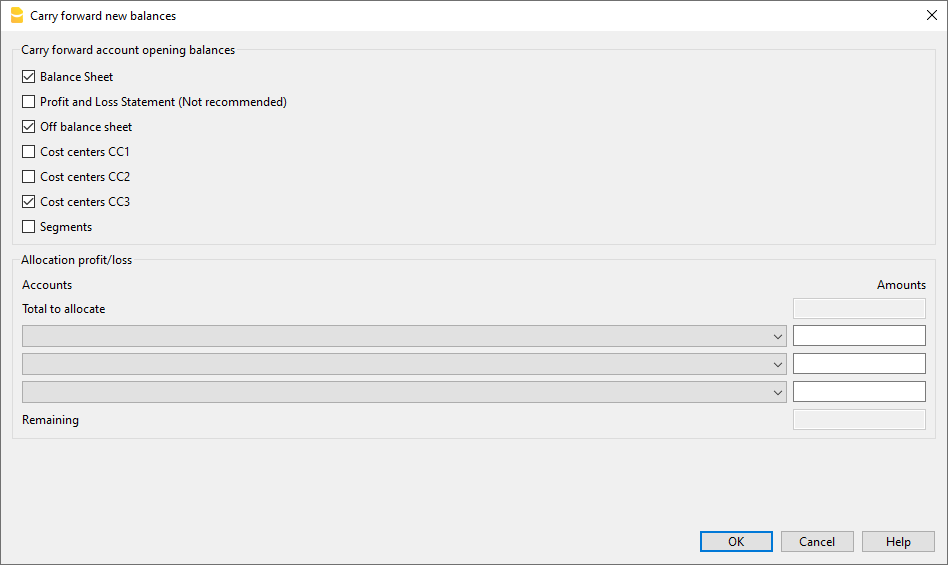
Carry forward account opening balances
The opening balances of the enabled items are carried forward:
Balance Sheet
Carries forward the balances of assets, liabilities and equity accounts. This option should generally be enabled.
Profit & Loss Statement (not recommended)
The balances of expense and income accounts must NOT be carried forward to the new year.
Enable this option only in special cases and only if you are certain of what it implies.
Off-balance sheet
Carries forward accounts with BClass (5 and 6 for off-balance sheet asset and liability accounts and 7 - 10 for other off-balance sheet accounts). If the closing balances of these accounts should not be carried forward, disable the corresponding option.
Cost centers
These should only be enabled when cost centers are used to manage positions that need to continue over time, such as customers, suppliers and partners.
CC1 Cost centers
Those beginning with a dot ".".
CC2 Cost centers
Those beginning with a comma ",".
CC3 Cost centers
Those beginning with a semicolon ";".
For more information, see the Cost/Profit Centers page.
Segments
Segment opening balances are created with opening transactions in the Transactions table.
- For more information, see the Segments page.
- The program creates one transaction for each account and segment combination, exactly reproducing the closing situation of the previous year.
- It is preferable not to enter segment opening balances using the Opening column. If this was done in the previous year, the program will carry the balance forward again to the Opening column of the new year.
Note: adjustment operations, such as recording and closing transitory accounts, must be entered manually.
Total to allocate
The program automatically indicates the amount of profit or loss to be allocated.
Accounts
Select the account or accounts (up to three) to which the year's result should be allocated. If there are several accounts to which the year's result is to be allocated, the amount must be entered manually in the appropriate fields.
If only one account is specified, the amount is automatically entered in the account selected from the list.
The program automatically updates the opening balances. Total assets correspond exactly to total liabilities.
Allocating the year's result to more than three accounts
In this case, automatically allocate the year's result only to the Retained Earnings/Losses account and continue with the creation of the new year.
In the new year (new file), in the Transactions table, enter a composed transaction to transfer the year's result from the Retained Earnings/Losses account to the desired accounts.
Postpone the allocation of the year's profit or loss
If you do not yet want to allocate the year's result, you can still proceed with creating the new year by clicking the OK button. You can subsequently allocate the year's result from the Actions > Update Opening Balances menu. The program displays the same window that appears with the Create New Year command.
Save the new file
The program creates a new accounting file for the new year:
- Confirm the Basic Data for the new year. The program carries forward the headings from the previous year and automatically enters the start and end dates of the new year.
- Click the File menu > Save As and specify the folder where you want to save the new accounting file. We recommend using the company name and year as the file name.
See also Organize accounting files.
If there are differences or other error messages, you can choose not to save the file that was created and repeat the operation to create the new year's file later.
Work on two years at the same time
After creating the new file, you can work on both years in parallel:
- New year's file
- Enter the transactions for the new accounting year.
- You can modify the chart of accounts, VAT and segments without affecting the previous year.
- If you have made changes to the previous year's file, use the Actions > Update Opening Balances command.
- Previous year's file
- Complete the transactions.
- Perform closing operations, checks, printouts and controls.
Professional Plan message with Advanced features up to 70 rows
If you use Banana Accounting Plus – Professional Plan, after creating the new file the following message appears:
Active subscription: Professional Plan. Advanced plan features are available for up to 70 transactions.
The message only indicates that Advanced features are available free of charge for up to 70 rows.
It does not affect the use of the Professional Plan in any way, which remains unlimited in terms of transactions.
The message automatically disappears once 70 rows are exceeded.
Checks in the new accounting year
After creating the new file:
- Run the Create New Year command.
- Check the opening balances that were carried forward automatically.
- Check that the year's profit or loss has been correctly recorded.
- Do not delete accounts in the new year that have a closing balance in the previous year.
- If you use multi-currency double-entry accounting, make sure that you have automatically calculated and recorded the exchange rate differences.
Update opening balances
After saving the file for the new year and making changes in the previous year, click Actions > Update Opening Balances to retrieve the opening balances and allocate the profit again.
This operation can be repeated several times and can be performed safely. Data integrity during the transition to the new year is guaranteed and no data is lost.
If, with the new year, you want to switch to another type of accounting (with multi-currency or VAT), create the new file and then use the Tools > Convert to New File command.
If instead you want to create a copy of the file without carrying forward the balances, use the Tools > Create File Copy command.
Modify balances carried forward
Once the balances have been carried forward to the new year (new file), if you need to modify the opening balances, they can be changed manually by changing the amounts in the following columns:
- Opening in the Accounts table.
- Previous (Accounts table > Previous view), for balances relating to the previous year.
- In the Transactions table for Segments.
If you have made changes to the previous year's file, click Actions > Update Opening Balances to retrieve and update the opening balances again.
Recheck the Rules in the Recurring Transactions table
When you run the Create New Year command, the program carries forward to the new year's file all transactions that have Rules.
Before recording the transactions for the new year, it is advisable to check and update all Transactions with Rules in the Recurring Transactions table.
If the conditions are no longer valid, you can:
- Modify the account, contra account, VAT code, CC3 or segments.
- Delete transactions that are no longer current.
- Add new transactions with Rules.
If, in the Recurring Transactions table, in addition to transactions with Rules, you have also saved:
you must also check and update these.
Performing this check immediately helps prevent errors and subsequent corrections in both the Transactions table and the Recurring Transactions table.
Carry forward texts to the new year / Smart Fill
When a new year is created, the descriptive texts from the previous year are also transferred. This feature makes entering transactions in the new year easier and faster.
If you do not want descriptive texts from the previous year to be automatically carried forward, simply disable the Smart Fill feature:
- from the File > File Properties (Basic Data) > Options menu.