In this article
At Lucerne Business School (WML), students in their second year of training set up their own startup as part of the FMZ Startup Academy and manage its accounts with Banana Accounting. Thibault Hutzli, who teaches accounting, economics, law and professional practice at FMZ in Lucerne, observes that working with their own company's transactions increases motivation: students understand how the knowledge gained in class is useful and why it is important to keep track of their startup's finances.
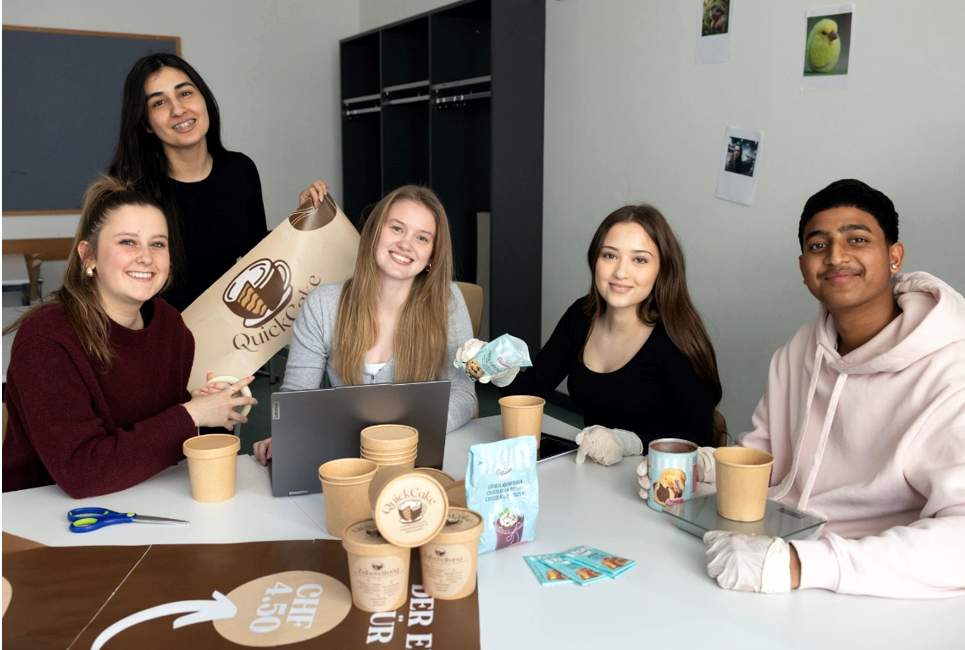
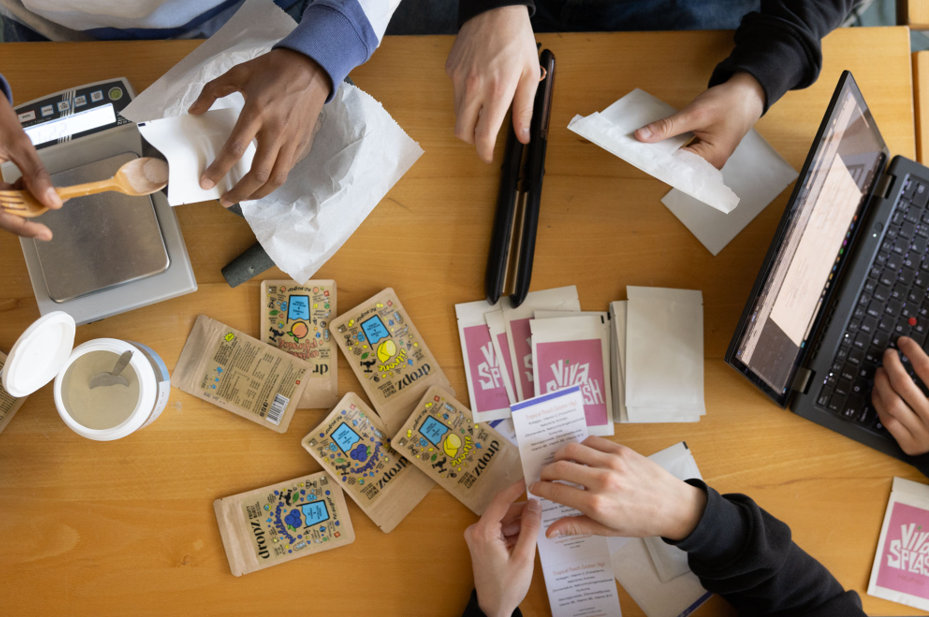
Students at work on production
One afternoon a week devoted to their own startup
For Thibault Hutzli, the key factors are the time available and the link between theory and practice. During regular lessons, preparation for the vocational baccalaureate exam leaves little time to work with accounting software. At the FMZ Startup Academy, however, Business School students have a full afternoon of four lessons every week for an entire school year. There is also a project week devoted to startups. In groups of five to seven, students develop a product or service, find financial backers, create a website, advertise and sell at markets and online. In 2026, the programme includes twelve startups, supported by four economics teachers and one IT teacher.
Working with external partners is also important. Lucerne Cantonal Bank (LUKB) reviews the startups' business plans, giving students feedback from a bank's perspective. It also recognises the best project with the FMZ LUKB Startup Award. The organisations «youthstart.network» and «myIdea.ch» hold competitions for young startups, which Lucerne Business School regularly enters. A Christmas market and the Mall of Switzerland shopping centre also give students the opportunity to sell their products directly.

A startup at the Mall of Switzerland
How students manage their accounts with Banana
As soon as a startup begins operating, the first business transactions arise: funding received, a product sold or an invoice for website hosting. VAT and accounting for inventory are also topics to address. Together with their teachers, students adapt the chart of accounts to their startup, rename some accounts and handle specific cases, such as recording TWINT fees.
The accounting routine follows the monthly closing cycle. Students collect and number their supporting documents, photograph them and submit a balance sheet and profit and loss statement to their teachers for review each month. They also create QR invoices, customising them with their startup's details and logo. Thibault Hutzli often notices how pleased students are when they see the results of their work: the transactions they have entered themselves become their company's reports and invoices.
Thibault Hutzli estimates that a startup records around 50–80 transactions a year and generates revenue of between CHF 1,000 and CHF 2,000. The workload is manageable, but requires accuracy and perseverance. The accounts also provide important data for the financial section of the business plan, which LUKB reviews.
Why the school chose Banana
To enable students to manage the accounts alongside the project's other activities, the school was looking for a program they could learn to use quickly. It chose Banana Accounting.
«Simple is the first word that comes to mind. The program is very intuitive and easy to use. And it works: it offers everything you need.»
Personal experience also contributed to the decision: some teachers already knew Banana through their work with associations and appreciated how easy it was to use. Banana is accounting software with an interface based on tables, similar to Excel. It allows users to record transactions, create invoices and prepare balance sheets and profit and loss statements. For the Startup Academy, these features meet the groups' everyday needs.
When switching from the previous software, Thibault Hutzli found that working with Banana was simpler and more straightforward. He learned to use the program on his own, using the available instructions and videos, and later prepared a manual for students. The free licence for schools also played an important role: it is a real advantage for a project with a limited budget. However, Thibault Hutzli stresses that Banana would have been one of his first choices even without this offer.
When the figures are their own
|  Thibault Hutzli, Startup Academy teacher |
Some students continue to use Banana later on, both at work and in associations. According to Thibault Hutzli, this experience also provides a good foundation for learning to use other accounting programs.
As often happens with group work, there is a risk during the project that the day-to-day bookkeeping will fall to one or two particularly interested students, while the others prefer to focus on different activities. For this reason, teachers make sure that several people in each startup are responsible for the accounts. During the project week, all students are required to study accounting in greater depth and then take an exam on the subject. The exam has two parts: in the first, students complete transaction recording exercises on the Moodle learning platform. In the second, they enter the same transactions in Banana and create an invoice, a balance sheet and a profit and loss statement, also paying attention to a neat presentation.
The teachers' role changes too: classroom instruction gives way to more guidance and support. Teachers work with the groups and step in when difficulties arise, whether in managing activities or in collaboration between students. When conflicts occur, for example over the distribution of tasks or the choice of product, they help students find a solution. These situations are also part of the experience of running a company together.

The FMZ school building in Lucerne
Accounting thinking and digital tools
For Thibault Hutzli, the development of artificial intelligence makes the ability to think independently even more important. There is a risk that students will accept an automatically generated answer without really understanding it. For this reason, during regular theory lessons, he deliberately chooses to work in the traditional way, with pen and paper. At the FMZ Startup Academy, however, students also learn to use artificial intelligence for specific purposes. The school provides the necessary tools and experiments together with students to identify where they can be used effectively. In this way, students combine skilled use of digital tools with the ability to think independently and understand a subject thoroughly. A dedicated programme such as the «FMZ Startup Academy» makes all this possible. Given the many learning objectives, it is difficult to work consistently with accounting software during regular lessons. Thibault Hutzli therefore recommends setting aside lessons specifically for projects that offer practical experience in a meaningful context, just as the Startup Academy does. FMZ's experience shows that the way teaching is organised is also crucial to successfully connecting theoretical knowledge with its practical application.