Templates
Banana Accounting provides ready-to-use templates for managing securities and financial investments using double-entry accounting.
You can manage investments within your general accounting file or in a separate investment accounting file, depending on your needs.
Choose the approach that best suits your accounting structure:
Integrated Investment Accounting Templates
Manage your general accounting and investment portfolio in the same Banana Accounting file. This approach is suitable for businesses and individuals who want to maintain financial statements and detailed investment records together.
Separate Investment Accounting Templates
Manage securities and financial investments in a dedicated accounting file that operates independently of your general accounting.
This approach is particularly useful if you already use another accounting system or want to replace separate investment tracking spreadsheets.
Accounting Base Currency
All four templates use CHF (Swiss francs) as the default accounting base currency. You can change the base currency under File > File and accounting properties... in Banana Accounting, preferably before entering transactions.
For more information about the available accounting features, see the Investment Accounting documentation.
Integrated Investment Accounting
These templates allow you to manage securities and other investments directly within your financial accounting. Investment transactions, balances, income, and gains or losses are recorded in the same Banana Accounting file as your other financial activities.
Choose the template according to the currencies used for your investments:
- Double-Entry Accounting with Integrated Investment Accounting – Manage investments in the accounting base currency, with investment transactions recorded directly in double-entry accounting.
- Double-Entry Multi-Currency Accounting with Integrated Investment Accounting – Manage investments denominated in different currencies, including exchange rate differences, within the same multi-currency accounting file.
Both templates use CHF as the default accounting base currency.
Documentation
For more information about managing investments within your general accounting file, see the Investment Accounting documentation.
For instructions on setting up investment accounting and recording transactions, see How to Start.
Double-Entry Accounting with Integrated Investment Accounting
In this article
Double-Entry Accounting with Integrated Investment Accounting
Double-Entry Accounting with Integrated Investment Accounting
This predefined template provides a ready-to-use example of double-entry accounting with integrated Investment Accounting for high-net-worth individuals (HNWIs). All investments are managed in the accounting base currency, together with the main components of personal wealth, including cash and bank accounts, real estate, other personal assets, liabilities, income, and costs. Individual investments, such as shares, bonds, and funds, are managed through the Items table and the corresponding Investment Balance Sheet Accounts, providing a complete view of the individual's investments, financial position, and results.
Open in Banana WebApp
Run Banana Accounting Plus on your browser without any installation. Customize the template, enter the transactions and save the file on your computer.
Open template in WebAppTemplate documentation
The tutorial file provides a ready-to-use example of integrated Investment Accounting, where the company's financial accounting and the detailed management of investments are maintained in the same Banana Accounting file.
All investments are managed in the accounting base currency, making this template suitable for learning and applying the basic principles of Investment Accounting without the additional complexity of foreign currencies.
The file includes a complete accounting structure for recording both the company's general business activities and its investment transactions. Investment-specific information, such as quantities, prices, Book Values, and Market Values, is managed alongside the corresponding accounting entries.
The template uses CHF (Swiss francs) as its default accounting base currency and is suitable for portfolios managed in a single currency. You can change the base currency to suit your needs, preferably before entering transactions. For instructions, see Change the Base Currency.
For more information about managing investments in Banana Accounting, see the Investment Accounting documentation. For setup instructions, see How to Start.
Chart of Accounts
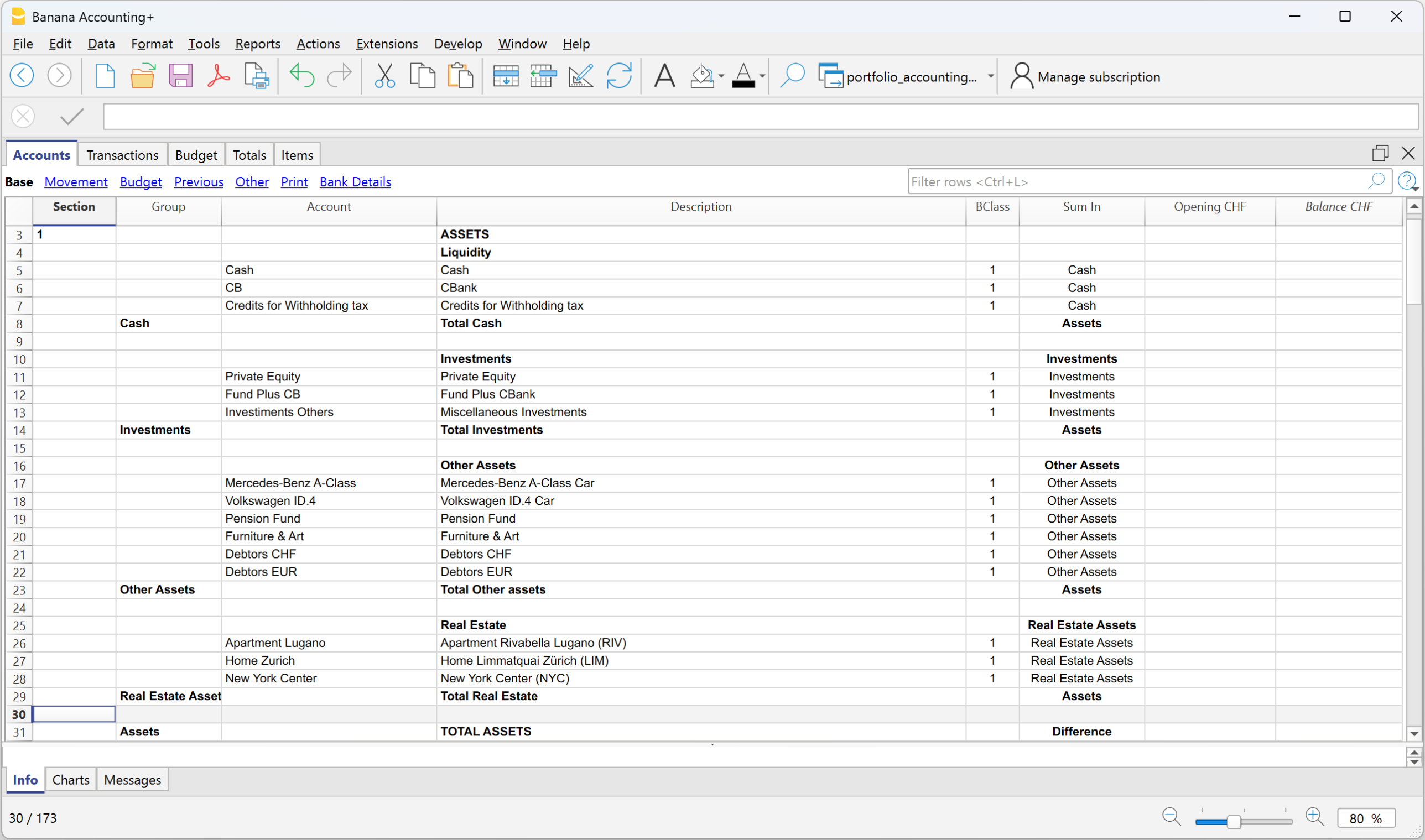
The chart of accounts provides a complete double-entry accounting structure for high-net-worth individuals (HNWIs), integrating Investment Accounting with the management of real estate properties, other personal assets, liabilities, income, and costs.
Balance Sheet Accounts
The Balance Sheet Accounts are organized into the following main categories:
- Cash and Equivalents, including cash, bank accounts, and withholding tax receivables
- Investments, with dedicated Investment Balance Sheet Accounts for securities and other financial investments
- Other Assets, including cars, pension assets, furniture and art, and receivables
- Real Estate Assets, with separate accounts for each owned property
- Debts, including other debts, loans, and mortgages
- Equity, including equity and the current year profit or loss.
This structure makes it possible to manage securities, real estate properties, and other personal assets and liabilities within the same accounting file.
Profit & Loss Accounts
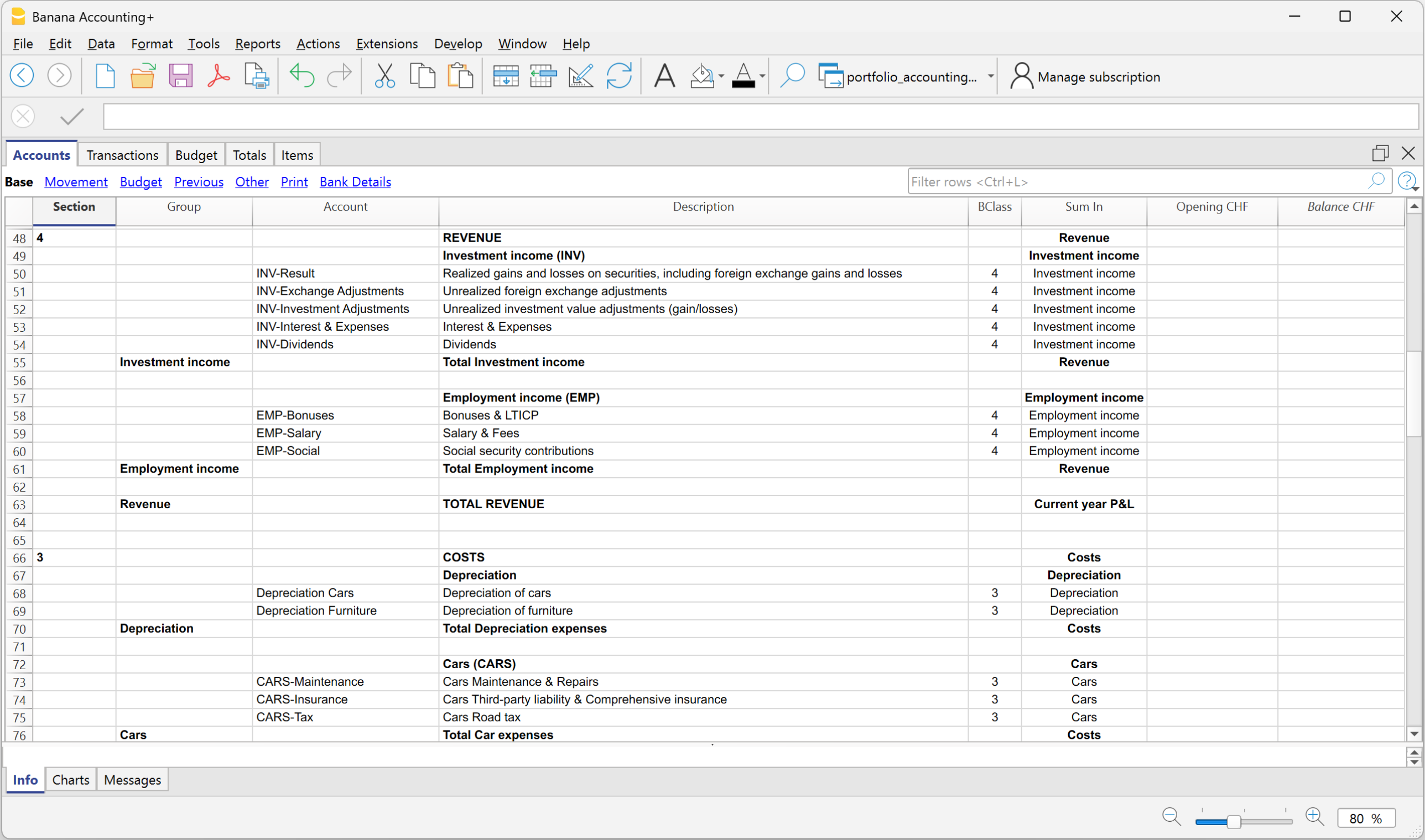
The Profit & Loss statement is structured to record both investment results and the other income and costs related to the individual's assets and personal finances.
Investment income and results include accounts for realized gains and losses on securities, foreign exchange results, unrealized investment and exchange rate adjustments, interest, dividends, and investment-related expenses.
The Profit & Loss statement also includes:
- Employment income, such as salary and bonuses;
- Depreciation, including depreciation of cars and furniture;
- Personal and asset-related costs, including cars, insurance, administration, legal fees, interest, taxes, health, and family costs;
- Real Estate Revenue and Costs, organized separately for each property, allowing rental and other income to be compared with utilities, insurance, maintenance, condominium fees, and other property-specific costs.
The structure therefore makes it possible to determine the overall financial result while also keeping investment results and the results of individual real estate properties clearly identifiable.
Because Investment Accounting is integrated into the financial accounting, purchases, sales, investment income and costs, realized gains and losses, and valuation adjustments are recorded directly in the same accounting file and are reflected in the corresponding Balance Sheet and Profit & Loss accounts.
Managing Quantities, Prices, and Values
The details of individual investments are managed in the Items table. The tutorial file includes sample shares and bonds and shows how investment-specific information can be maintained alongside the financial accounting.
For each investment, the Items table contains information such as the Item identifier, description, Asset Account, Quantity, Unit Price, Book Value, Market Price, and Market Value.
For more information, see the Items page.
Transactions
Investment transactions are recorded directly in the same Transactions table used for the company's general accounting.
The tutorial file contains example transactions covering the main investment operations, such as purchases, sales, income, costs, realized gains and losses, and valuation adjustments.
Because the investment transactions are part of the double-entry accounting, their accounting effects are immediately reflected in the corresponding accounts and in the company's Balance Sheet and Profit & Loss statement.
For more information, see Investment Accounting Transactions.
Other Resources
Other Banana Accounting templates are available depending on how you want to manage your investments:
- Double-Entry Multi-Currency Accounting with Integrated Investment Accounting – for managing investments denominated in foreign currencies directly within multi-currency double-entry accounting.
- Multi-Currency Investment Accounting in a Separate File – for keeping detailed Investment Accounting multicurrency in a separate Banana Accounting file that can be used as an investment subledger for your general accounting.
Multi-Currency Double-Entry Personal Wealth Accounting for HNWIs
In this article
Multi-Currency Double-Entry Personal Wealth Accounting for HNWIs
Multi-Currency Double-Entry Personal Wealth Accounting for HNWIs
This ready-to-use template combines multi-currency double-entry accounting with integrated Investment Accounting to provide a comprehensive view of personal and family wealth. It covers financial investments, bank accounts, real estate, other personal assets, liabilities, income and expenses. Applying the same structured accounting principles used by businesses, it enables High-Net-Worth Individuals (HNWIs) and their advisors to monitor their financial position, track income and expenses, and understand how net worth evolves over time.
Open in Banana WebApp
Run Banana Accounting Plus on your browser without any installation. Customize the template, enter the transactions and save the file on your computer.
Open template in WebApp Open tutorial in WebAppTemplate documentation
This ready-to-use template provides a comprehensive double-entry accounting framework for managing the personal wealth of High-Net-Worth Individuals (HNWIs), combining multi-currency accounting with integrated Investment Accounting.
The accounting structure covers the individual's entire wealth, including cash and bank accounts in multiple currencies, financial investments, real estate, vehicles, pension assets, furniture, art collections, receivables, loans, mortgages, and other liabilities.
The Profit & Loss accounts complement the balance sheet by tracking investment income and gains or losses, employment and other income, depreciation, taxes, personal and family expenses, as well as income and expenses related to individual real estate properties.
Just as businesses rely on financial statements to understand their financial position and performance, this template brings the same structured accounting approach to personal wealth management. It provides a comprehensive view of assets, liabilities, income and expenses, helping individuals and their advisors understand how net worth evolves over time.
The template uses CHF (Swiss francs) as its default accounting base currency and supports investments and transactions in other currencies, such as EUR and USD. You can change the base currency to suit your needs, preferably before entering transactions. For instructions, see Change the Base Currency.
For more information about managing securities and financial investments within the same accounting file, see the Investment Accounting documentation.
Chart of Accounts Structure and Customization
The Chart of Accounts uses a hierarchical grouping structure to organize accounts and automatically present subtotals and results at different levels of detail. This makes it easy to obtain both an overall financial overview and detailed information on specific assets, investments, and individual properties.
The Chart of Accounts is designed to be fully customizable. Additional accounts and groups can be created to reflect individual needs and the complexity of the wealth being managed.
For Family Offices managing multiple clients, the accounting structure can be tailored to each individual or family, ensuring that financial reporting reflects their specific assets, activities, and reporting requirements.
Balance Sheet Accounts
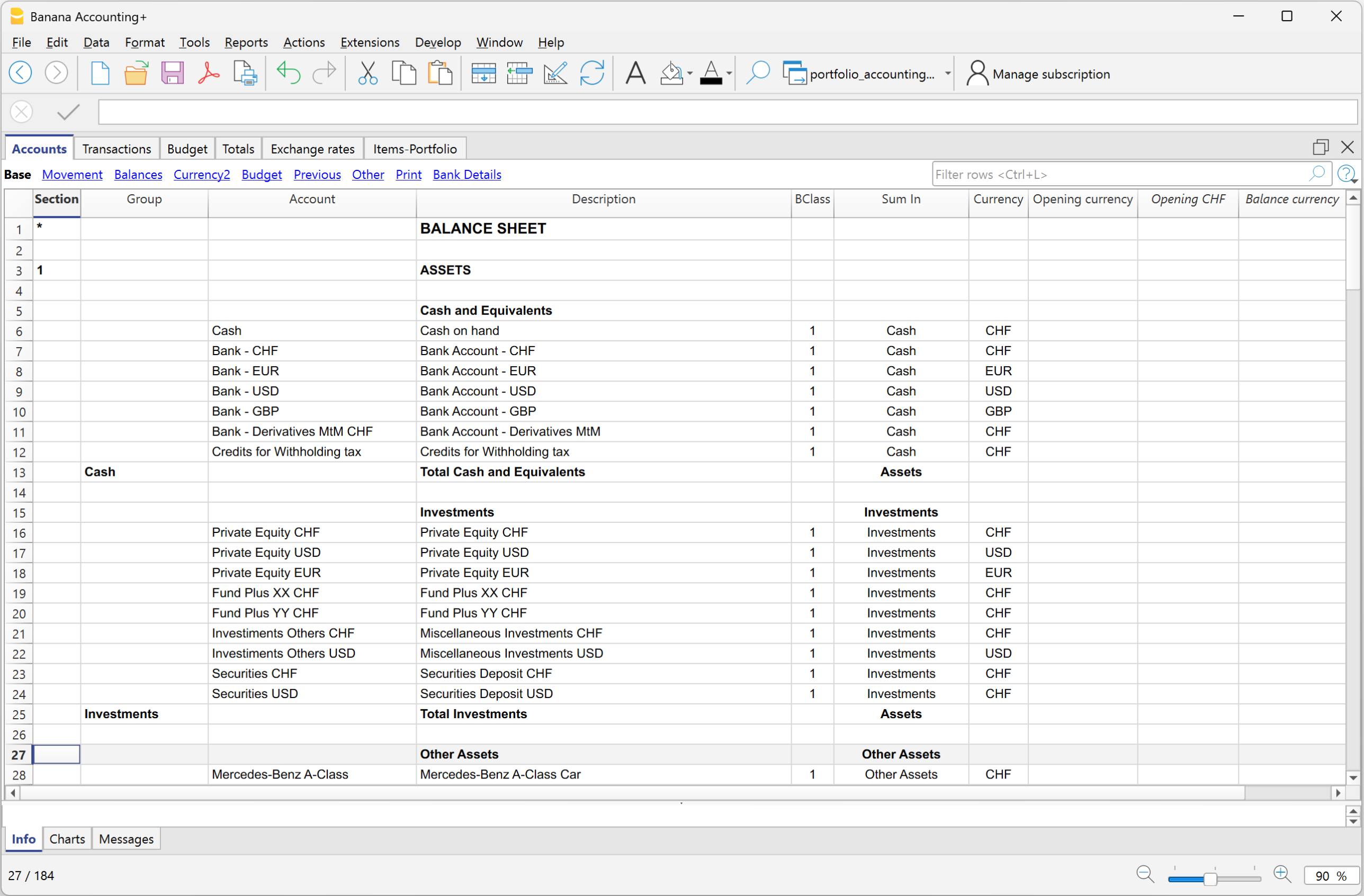
The Balance Sheet Accounts provide the accounting structure for managing the individual's assets, liabilities, and equity.
They are organized into the following main categories:
- Cash and Equivalents, including cash, bank accounts in different currencies, derivative positions, and withholding tax receivables;
- Investments, with dedicated Investment Balance Sheet Accounts for securities and other financial investments in different currencies;
- Other Assets, including cars, pension assets, furniture and art, and receivables;
- Real Estate Assets, with separate accounts for each owned property;
- Debts, including other debts, loans, and mortgages;
- Equity, including equity and the current year profit or loss.
For Investment Accounting, each security maintained in the Items table is linked through its Asset Account to the corresponding Investment Balance Sheet Account. This makes it possible to maintain detailed information for individual securities while keeping their accounting values fully integrated into the Balance Sheet.
Profit & Loss Accounts
The Profit & Loss accounts are structured to record income, expenses, and financial results related to the individual's personal wealth, investments, and activities.
They include:
- Investment Income and Results.
Realized gains and losses on securities, foreign exchange gains and losses, unrealized investment and exchange rate adjustments, interest, dividends, and investment-related expenses. - Employment Income.
Salaries, fees, bonuses, and related social security contributions. - Depreciation.
Depreciation of vehicles, furniture, and other depreciable assets. - Personal and Asset-Related Expenses.
Vehicle expenses, insurance, administrative and legal fees, loan interest, taxes, healthcare, family expenses, and other personal costs. - Real Estate Income and Expenses.
Dedicated income and expense accounts are organized and grouped by individual property, covering rental income, other revenue, utilities, insurance, maintenance, condominium fees, and other property-related expenses. This structure makes it easy to monitor the income, expenses, and net result of each property.
This account structure provides a comprehensive overview of the individual's financial results while allowing investment performance and the profitability of individual real estate properties to be analyzed separately.
Account Naming Conventions
In this template, income and expense accounts related to specific investments are prefixed with a short code identifying the corresponding investment. For example, the prefix RIV identifies income and expenses associated with the Apartment Rivabella real estate investment.
This naming convention makes it easy to immediately identify which investment each account relates to, improving clarity and organization.
It is particularly useful when managing multiple investments, as it simplifies the tracking of income and expenses and the analysis of each investment's profitability.

Cost Centers and Segments
The template includes predefined Cost Centers (CC1, CC2, and CC3) and Segments, providing additional flexibility for tracking expenses and analyzing financial information.
Cost Centers are used to track income and expenses related to specific activities, such as trips, vehicles, or personal projects, independently of the main Chart of Accounts. They make it easy to monitor the total costs of each activity, even when expenses are recorded under different accounts.
Segments provide a more structured way to divide accounting information into separate reporting units. They can be used to generate Balance Sheets and Profit & Loss Statements by segment, making it possible to analyze the financial position and results of different activities or components of personal wealth.
Both Cost Centers and Segments can be customized and expanded to meet individual needs, allowing HNWIs, accountants, and Family Offices to adapt the accounting structure to their specific reporting requirements.
Items Table – Investment Portfolio
The Items table contains the list of securities and other financial investments, such as stocks, bonds, ETFs, and investment funds.
Each investment is identified by a unique code (such as an ISIN) and linked to its corresponding Balance Sheet account. The table tracks quantities, currencies, opening values, and current market prices, automatically calculating current quantities and market values.
Investments can be organized into customizable groups, making it easy to view subtotals by asset category.
Together with the Chart of Accounts and the Transactions table, the Items table provides an integrated view of the investment portfolio, combining detailed securities information with double-entry accounting and portfolio valuation.
Exchange Rates Table
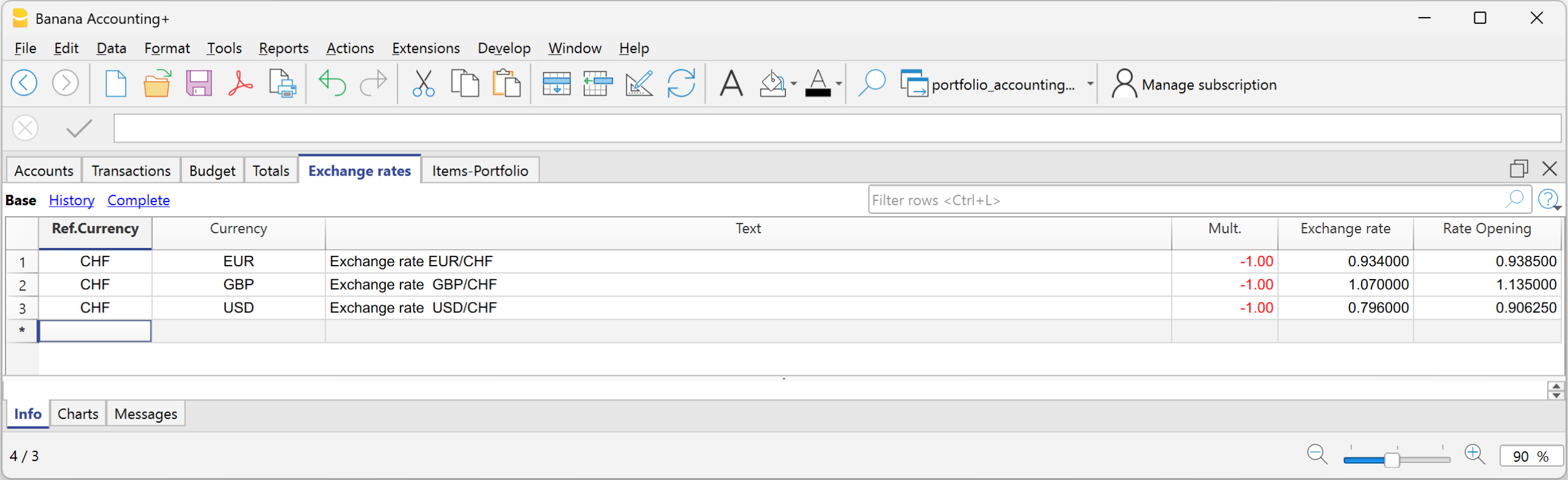
The Exchange Rates table contains the currencies used in the accounting system and their exchange rates relative to the base currency.
It allows transactions, account balances, and investments denominated in different currencies to be managed and converted into the base currency.
Exchange rates can be updated to reflect current market values, enabling the calculation of exchange rate differences and the preparation of consolidated financial statements in the base currency.
The table supports both standard currency codes (such as CHF, EUR, and USD) and custom codes, including those used for cryptocurrencies and other digital assets.
Currencies, codes, and exchange rates can be freely customized, providing the flexibility to adapt the accounting system to different countries, currencies, and individual requirements.
Other Resources
Other Banana Accounting templates are available depending on how you want to manage your personal accounting and investments:
- Double-Entry Accounting with Integrated Investment Accounting – for managing personal wealth and investments directly within double-entry accounting when securities are managed in the accounting base currency.
- Multi-Currency Investment Accounting in a Separate File – for keeping detailed multi-currency Investment Accounting in a separate Banana Accounting file that can be used as an investment subledger for your general accounting.
Separate Investment Accounting Templates (Subledger)
These templates allow you to manage securities and other financial investments in a separate Banana Accounting file, independently of your general accounting.
The separate file acts as an Investment subledger, maintaining detailed information about individual investments, transactions, quantities, prices, Book Values, and Market Values. The corresponding accounting balances and financial results can be recorded in your general accounting, even when it is maintained using other software.
Choose the template according to the currencies used for your investments:
- Double-Entry Investment Accounting in a Separate File – Manage investments in the accounting base currency using a separate double-entry accounting file. (Template coming soon.)
- Multi-Currency Investment Accounting in a Separate File – Manage investments denominated in different currencies, including exchange rate differences, in a separate accounting file.
Both templates use CHF as the default accounting base currency.
For more information about how separate investment accounting works, including investment transactions and reconciliation with your general accounting, see the Separate Investment Accounting (Subledger) documentation.
Double-Entry Accounting with Separate Investment Accounting
In this article
Double-Entry Accounting with Separate Investment Accounting
Double-Entry Accounting with Separate Investment Accounting
Manage securities and financial investments in a separate Banana Accounting file using double-entry accounting. Track shares, bonds, funds, purchases, sales, dividends, interest, and investment gains and losses, independently of your general accounting.
Open in Banana WebApp
Run Banana Accounting Plus on your browser without any installation. Customize the template, enter the transactions and save the file on your computer.
Open template in WebApp Open tutorial in WebAppTemplate documentation
This ready-to-use template provides a comprehensive double-entry accounting framework for managing the personal wealth of High-Net-Worth Individuals (HNWIs), combining multi-currency accounting with integrated Investment Accounting.
The accounting structure covers the individual's entire wealth, including cash and bank accounts in multiple currencies, financial investments, real estate, vehicles, pension assets, furniture, art collections, receivables, loans, mortgages, and other liabilities.
The Profit & Loss accounts complement the balance sheet by tracking investment income and gains or losses, employment and other income, depreciation, taxes, personal and family expenses, as well as income and expenses related to individual real estate properties.
Just as businesses rely on financial statements to understand their financial position and performance, this template brings the same structured accounting approach to personal wealth management. It provides a comprehensive view of assets, liabilities, income, and expenses, helping individuals and their advisors monitor how net worth evolves over time.
The template uses CHF (Swiss francs) as its default accounting base currency and is suitable for portfolios managed in a single currency. You can change the base currency to suit your needs, preferably before entering transactions. For instructions, see Change the Base Currency.
For details on managing securities and financial investments within the same accounting file, see the Investment Accounting documentation.
Balance Sheet Accounts
The Balance Sheet Accounts are organized into the following main categories:
- Cash and Equivalents, including cash, bank accounts, and withholding tax receivables
- Investments, with dedicated Investment Balance Sheet Accounts for securities and other financial investments
- Equity, including equity and the current year profit or loss.
Profit & Loss Accounts
The Profit & Loss statement is structured to record both investment results and the other income and costs related to the individual's assets and personal finances.
Investment income and results include accounts for realized gains and losses on securities, foreign exchange results, unrealized investment and exchange rate adjustments, interest, dividends, and investment-related expenses.
The Profit & Loss statement also includes:
- Income and Costs, Investment-related costs and revenues
- Finaly Resultat, Investment profit or loss.
The structure therefore makes it possible to determine the overall financial result while also keeping investment results and the results of individual real estate properties clearly identifiable.
Because Investment Accounting is integrated into the financial accounting, purchases, sales, investment income and costs, realized gains and losses, and valuation adjustments are recorded directly in the same accounting file and are reflected in the corresponding Balance Sheet and Profit & Loss accounts.
Managing Quantities, Prices, and Values
The details of individual investments are managed in the Items table. The tutorial file includes sample shares and bonds and shows how investment-specific information can be maintained alongside the financial accounting.
For each investment, the Items table contains information such as the Item identifier, description, Asset Account, Quantity, Unit Price, Book Value, Market Price, and Market Value.
For more information, see the Items page.
Transactions
Investment transactions are recorded directly in the same Transactions table used for the company's general accounting.
The tutorial file contains example transactions covering the main investment operations, such as purchases, sales, income, costs, realized gains and losses, and valuation adjustments.
Because the investment transactions are part of the double-entry accounting, their accounting effects are immediately reflected in the corresponding accounts and in the company's Balance Sheet and Profit & Loss statement.
For more information, see Investment Accounting Transactions.
Other Resources
Other Banana Accounting templates are available depending on how you want to manage your investments:
- Double-Entry Multi-Currency Accounting with Integrated Investment Accounting – for managing investments denominated in foreign currencies directly within multi-currency double-entry accounting.
- Multi-Currency Investment Accounting in a Separate File – for keeping detailed Investment Accounting in a separate Banana Accounting file that can be used as an investment subledger for your general accounting.
- Double-Entry Accounting with Integrated Investment Accounting – Manage investments in the accounting base currency, with investment transactions recorded directly in double-entry accounting.
Multi-Currency Investment Accounting in a Separate File
In this article
Multi-Currency Investment Accounting in a Separate File
Multi-Currency Investment Accounting in a Separate File
This predefined template provides a ready-to-use example for managing detailed Investment Accounting in a separate Banana Accounting file, which can be used as an investment subledger for your general accounting. It allows you to manage shares, bonds, and other investments in multiple currencies, keeping track of quantities, prices, Book Values, Market Values, realized and unrealized gains and losses, interest, dividends, and exchange rate differences. The template includes a predefined chart of accounts, an Items table, example transactions for the main investment operations, and an Exchange Rates table for managing investments in foreign currencies.
Open in Banana WebApp
Run Banana Accounting Plus on your browser without any installation. Customize the template, enter the transactions and save the file on your computer.
Open template in WebApp Open tutorial in WebAppTemplate documentation
With Banana Accounting, you can manage securities and financial investments in a separate accounting file, independently of your general accounting software.
This solution is particularly useful if you already use another accounting system or manage your investment portfolio with Excel spreadsheets. The separate file acts as an investment subledger, combining double-entry accounting with detailed portfolio management.
The Investment Accounting extension helps automate several operations, including calculating realized gains and losses on sales, creating adjustments for unrealized gains and losses, updating Market Prices, and calculating exchange rate differences for investments in foreign currencies.
The template uses CHF (Swiss francs) as its default accounting base currency and is suitable for portfolios managed in a single currency. You can change the base currency to suit your needs, preferably before entering transactions. For instructions, see Change the Base Currency.
For more information about how this solution works, see the Separate Investment Accounting (Subledger) documentation.
The Main Accounting File
In the general accounting file, you record all general accounting transactions, including the accounting values related to investments that are required for preparing the financial statements.
The Banana file can be used as an investment subledger: it maintains the details of individual investments and their related transactions, while in the general accounting you can record the required accounting values, including aggregated amounts by account or investment category.
Banana Investment Accounting File
In the Banana Investment Accounting file, you maintain all the details of individual investments, including quantities, prices, Book Values, Market Values, realized and unrealized gains and losses, as well as the related accounting transactions.
The file would replace the Excel files that you usually use to keep track of investments.
The following sections explain how the example file works and how to integrate the resulting accounting data into the general accounting.
Chart of Accounts
The chart of accounts in the example file is intentionally concise and has been created specifically for Investment Accounting and for using the functions provided by the Investment Accounting extension.
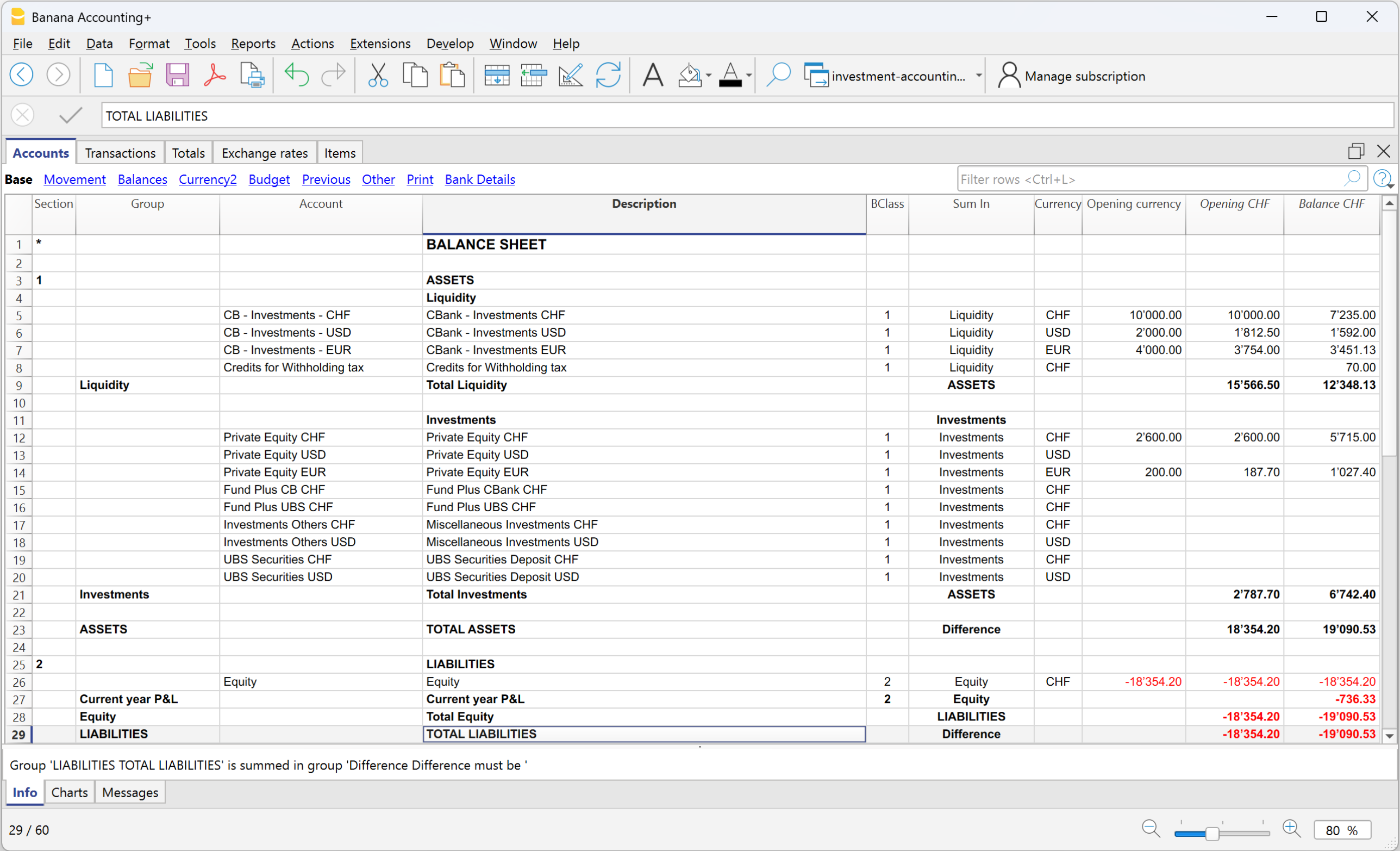
The Accounts table contains only the accounts required to record Investment Accounting transactions and obtain the related Balance Sheet and Profit & Loss statement values.
Balance Sheet
Asset Accounts
The Balance Sheet mainly includes bank accounts, investment accounts, and the withholding tax receivable account required for managing investments.
The example file includes separate accounts by currency to properly manage investments and their related multi-currency transactions.
The bank accounts in the Banana Investment Accounting file are technical accounts used as counterpart accounts for recording cash flows related to investments. Their balances do not necessarily correspond to the balances of the bank accounts in the general accounting, where the cash flows of the entire business are recorded.
Liability and Equity Accounts
These include Equity and the Current Year Profit or Loss required to complete the accounting structure of the file.
Profit & Loss Accounts
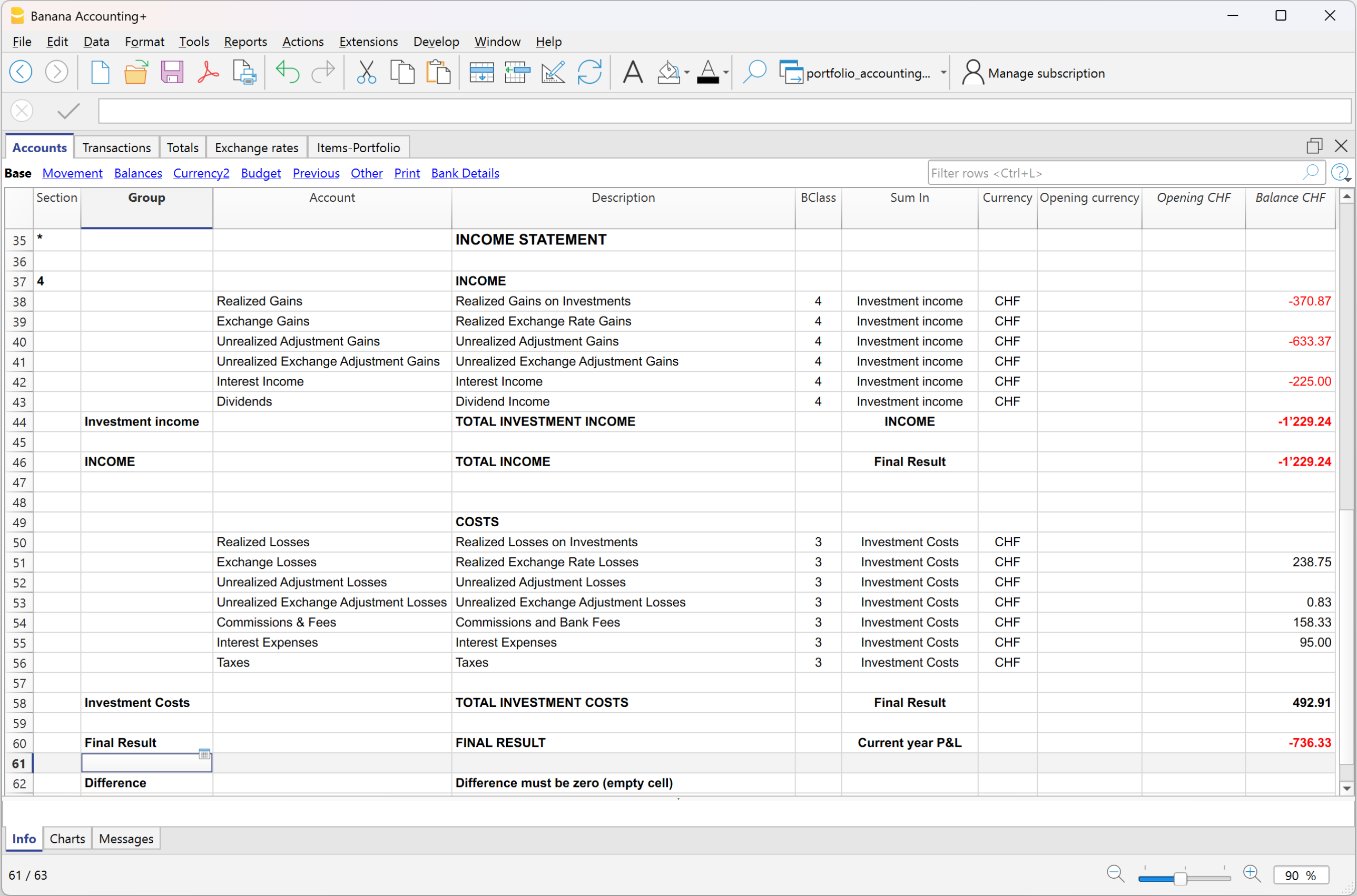
The Profit & Loss statement contains only the accounts required to record the income and expenses arising from investment transactions, such as interest, dividends, commissions and fees, realized gains and losses, unrealized value adjustments, and exchange rate differences.
Opening Balances
The opening balances of the Investment Balance Sheet Accounts are entered in the Accounts table. For each Investment Balance Sheet Account, the opening balance in the Banana file must correspond to the sum of the opening values of the Items linked to the same Asset Account.
Opening balance of the Investment Balance Sheet Account in the Banana file = Sum of the opening values of the linked Items
When the corresponding Investment Balance Sheet Account is also present in the general accounting, the opening balance from the Banana file must be consistent with the opening balance of the corresponding account in the general accounting:
Opening balance of the Investment Balance Sheet Account in the Banana file = Opening balance of the corresponding Investment Balance Sheet Account in the general accounting
Items Table - Portfolio
The details of individual investments are managed in the Items table. For each investment, the table contains information such as the Item identifier, description, Asset Account, Quantity, Unit Price, Book Value, Market Price, and Market Value.
For more information, see the Table Items page.

Transactions
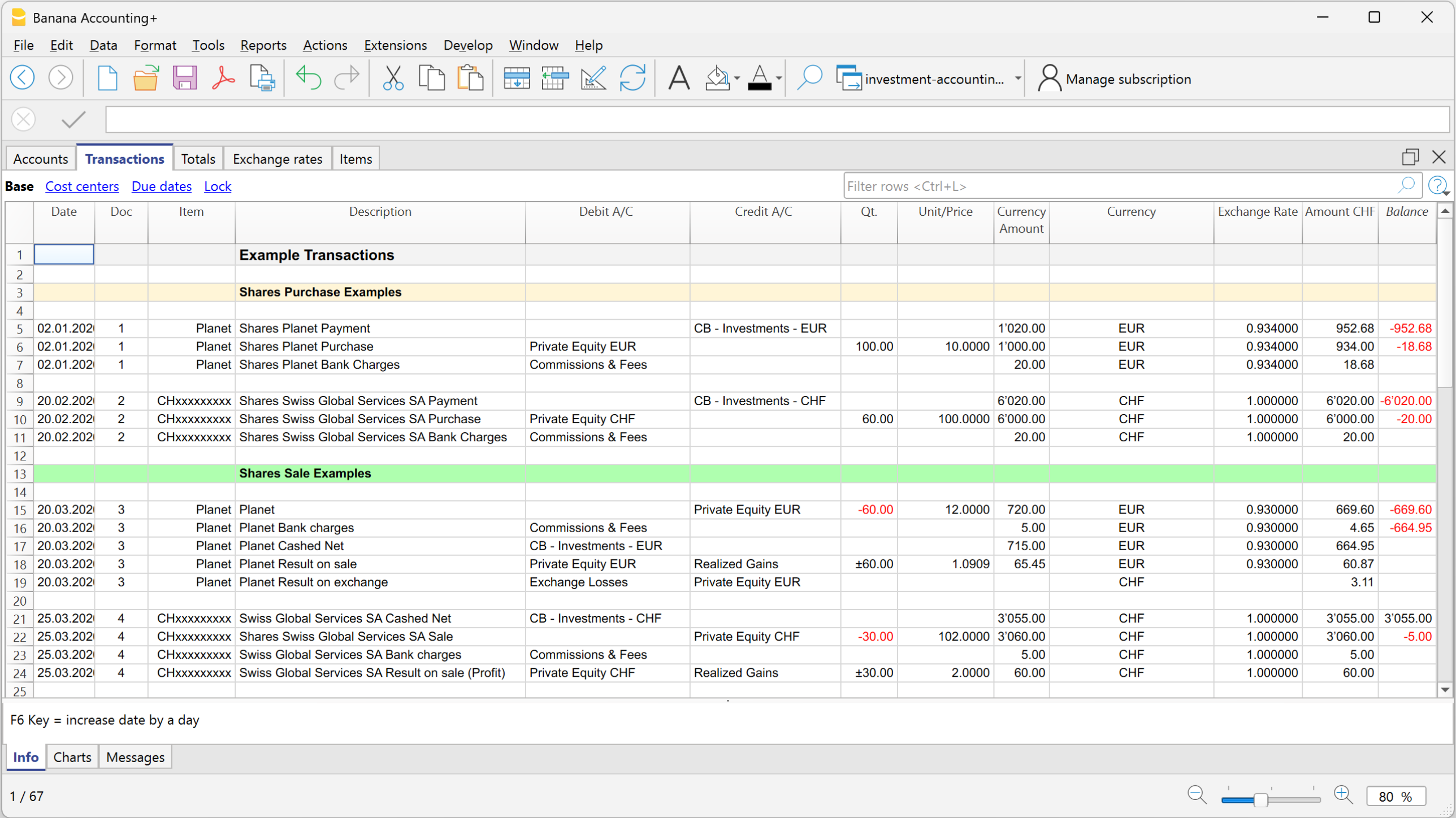
The example file contains transactions covering the main investment operations, including purchases, sales, dividends, interest, commissions and fees, realized gains and losses, value adjustments, and exchange rate differences.
The transactions contain both the standard double-entry accounting information and investment-specific information, such as Item, Quantity, and Unit Price.
For more information, see the Transactions page.
Updating and Reconciling the General Accounting
The Banana Investment Accounting file can be used as an investment subledger for your general accounting. It maintains the details of individual investments and their related transactions, while the required accounting values are recorded in the general accounting.
The transfer of these values is not automatic. You can update the general accounting in two main ways:
- Periodically, by keeping the detailed investment transactions in the Banana Investment Accounting file and transferring the required accounting values to the general accounting at regular intervals or when financial statements need to be prepared. This can be done, for example, at the end of a month, quarter, half-year, or year.
Important: When using periodic updates, it is not sufficient simply to record the difference between the opening and closing balance of an investment account. Purchases, sales, realized gains and losses, income, costs, and any applicable value or exchange rate adjustments must be transferred to the general accounting according to their accounting nature.
The values transferred to the general accounting can be recorded in aggregated form by investment account or category, provided that the required accounting information is maintained and the corresponding balances can be reconciled with the Banana Investment Accounting file.
- Transaction by transaction, by recording the corresponding accounting effects in the general accounting as the investment transactions are recorded in the Banana file.
After the required accounting values have been recorded in the general accounting, the Book Values resulting from the Banana file can be used to verify the corresponding investment account balances:
Book Value from the Banana file = Balance of the corresponding investment account in the general accounting
In this way, the Banana file maintains the detailed information for individual investments and their related transactions, while the general accounting contains the accounting values required for financial reporting.
Integrated Investment Accounting Templates
Other Resources
If you prefer to manage investments directly within your financial accounting instead of using a separate Investment Accounting file, you can use one of the following Banana Accounting templates with integrated Investment Accounting: