在此文中
The extension generates and displays a report with four types of checks:
- Comparison between the turnover declared in the VAT Return and the turnover recorded in the accounting file.
- Turnover declared in the VAT form, grouped by VAT code.
- Taxable VAT declared in the VAT form.
- Transactions for accounts with differences.
To generate the VAT Reconciliation report:
- Open the accounting file.
- From the Extensions menu, select Swiss Annual VAT Reconciliation > 1. Print report.
The extension Settings dialog will open. Here you can define the information required to create the VAT Reconciliation report:
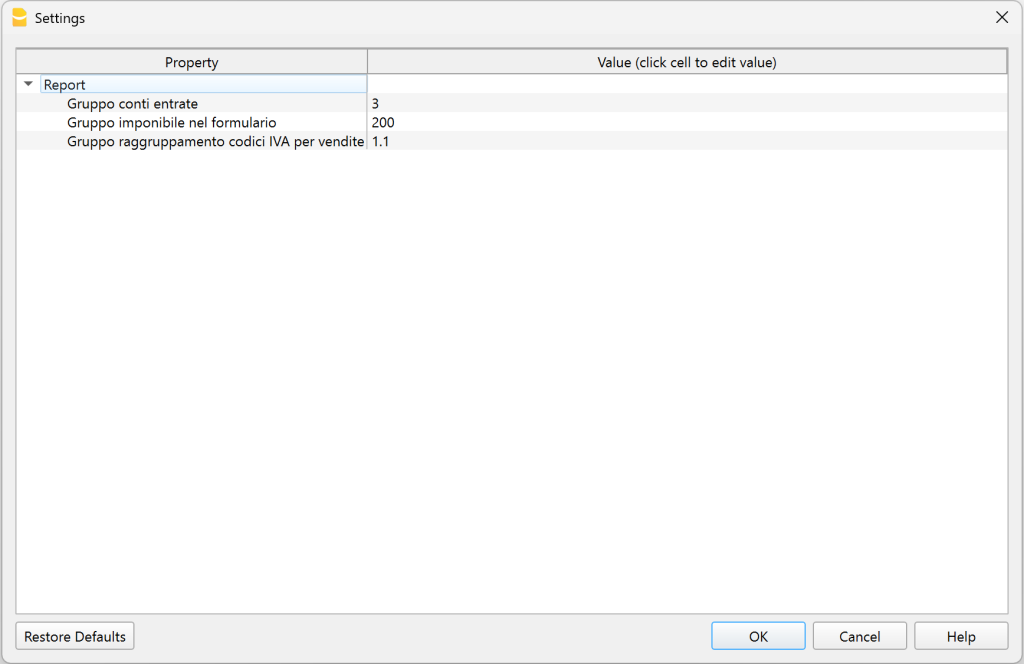
- Income accounts group.
Enter the main income group that includes all income accounts, as defined in the chart of accounts in the Accounts or Categories table (for Income & Expense accounting and Cash Manager). The default value is 3. In our example, the income group is 30.
If the turnover totalization group in your chart of accounts is different, you must change this value. - Taxable group in the VAT form.
Enter the group shown in the Gr1 column of the VAT Codes table that represents the value of box 200 of the VAT Return. The default value is 200. - VAT codes grouping for sales.
Enter the group shown in the Sum in column of the VAT Codes table that totals the sales VAT codes. The default value is 1.1.
- Income accounts group.
- Click OK to run the extension.
1. Comparison between the turnover declared in the VAT Return and the turnover recorded in the accounting file
This check compares the declared turnover with the turnover recorded in the accounting file and identifies any differences.
The following example is based on an accounting file where the displayed turnover is CHF 5'800.28.

The report generated by the extension contains tables divided by period, including an overall annual period.
Each table displays all the accounts that generate turnover, including accounts with transactions that do not have a VAT code.
Each table contains the following columns:
- Account
List of the accounts included in the turnover or with VAT transactions (including any balance sheet accounts). - Turnover with VAT code
Amount of turnover for each account where the transactions have a VAT code. - Turnover without VAT code
Amount of turnover for each account where the transactions do not have a VAT code. - Total turnover
Total turnover for each account, including both transactions with and without a VAT code. - Declared net amount
Net amounts declared in the VAT Return. - Differences
Differences between the turnover recorded in the accounting file and the declared turnover.
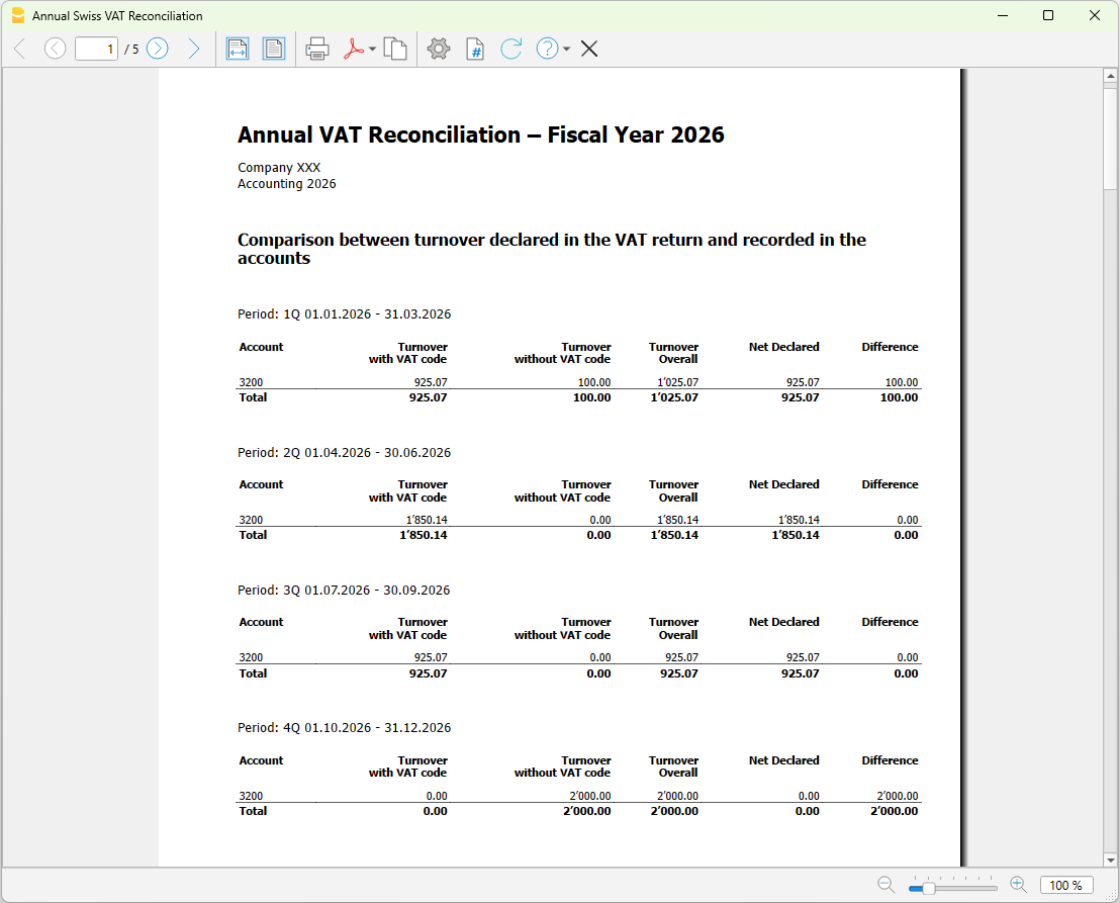
In the example, the report shows the calculation for account 3000 (Sales account), which represents the turnover:
- In the first quarter (1Q), there is a turnover difference of CHF 100.00 (Differences column).
- Turnover recorded in the accounting file = CHF 1'025.07 (Total turnover column).
- Turnover declared in the VAT Return = CHF 925.07 (Declared net amount column).
- In the fourth quarter (4Q), there is a turnover difference of CHF 2'000.00 (Differences column).
- Turnover recorded in the accounting file = CHF 2'000.00 (Total turnover column).
- Turnover declared in the VAT Return = CHF 0.00 (Declared net amount column).
- For the annual period, the differences from each period are added together and displayed:
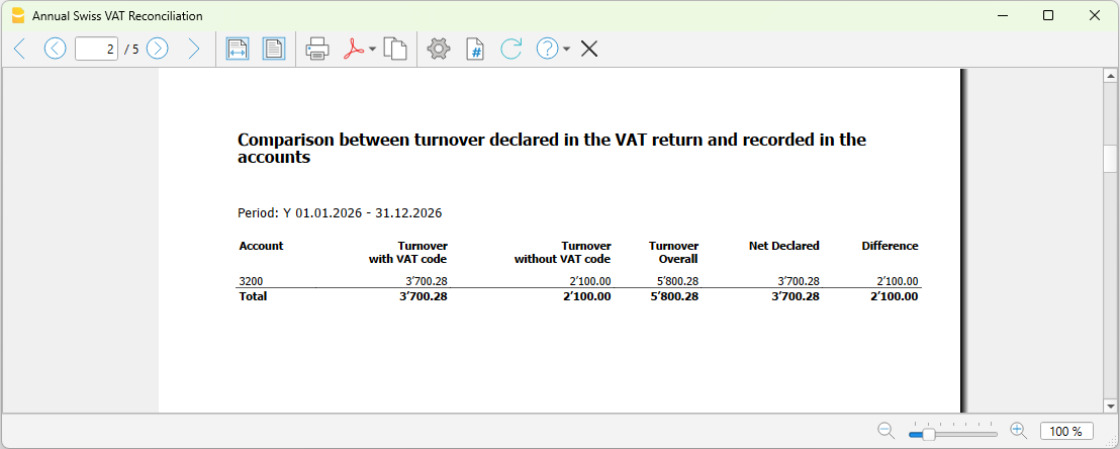
- Turnover recorded in the accounting file = CHF 5'800.28 (Total turnover column).
- Turnover declared in the VAT Return = CHF 3'700.28 (Declared net amount column).
- Total turnover difference = CHF 2'100.00 (Differences column).
2. Turnover declared in the VAT form, grouped by VAT code
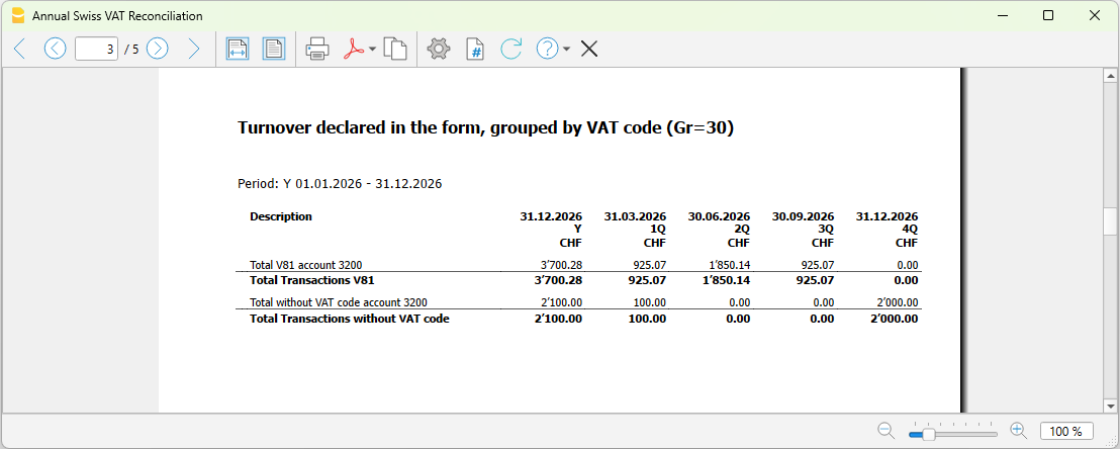
This check compares the turnover for each VAT code relating to income accounts with VAT.
- Description
Description of each VAT code used in the turnover transactions. - Taxable amount Y
Taxable amount for the year. - Taxable amount 1Q
Taxable amount for the first quarter. - Taxable amount 2Q
Taxable amount for the second quarter. - Taxable amount 3Q
Taxable amount for the third quarter. - Taxable amount 4Q
Taxable amount for the fourth quarter.
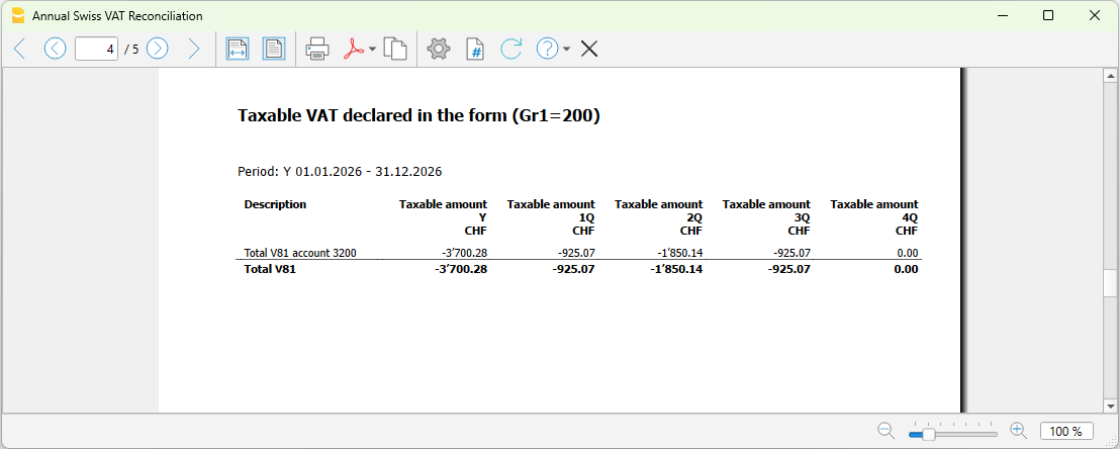
3. Taxable VAT declared in the VAT form
The report provides a summary of the VAT amounts declared to the Swiss Federal Tax Administration (FTA) for each quarter, without checking for any differences.
4. Transactions for accounts with differences
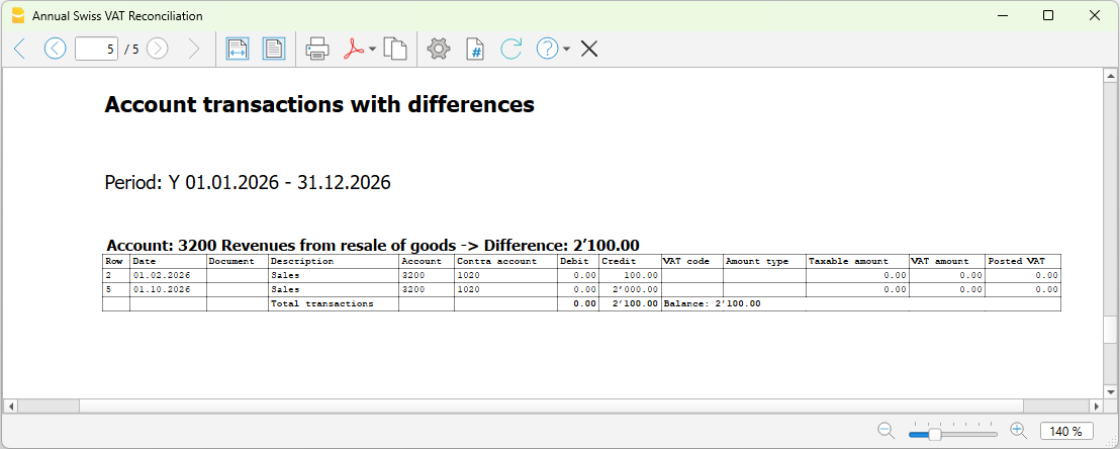
For each account, all transactions that generated differences in the various VAT Returns are grouped together.
The list of all transactions that generated differences allows you to quickly identify possible errors, such as a transaction subject to VAT that is missing the related VAT code, or to identify transactions that are correct but, although they have a VAT code, are not included in the turnover calculation (such as purchase tax or reverse charge transactions).
The following columns are displayed:
- Row
The row number of the transaction in the Transactions table. - Date
The transaction date. - Description
The transaction description. The description text is truncated to 20 characters to keep the table tidy and easy to read. - Account
The account with the transaction difference. - Contra account
The contra account of the transaction. - Debit
The debit amount of the transaction. - Credit
The credit amount of the transaction. - VAT code
The VAT code of the transaction. - VAT amount type
The VAT amount type of the transaction. - Taxable VAT amount
The taxable VAT amount of the transaction. - VAT amount
The VAT amount of the transaction. - Posted VAT amount
The posted VAT amount of the transaction.
In the example:
- The difference between the turnover recorded in the accounting file (CHF 5'800.28) and the turnover declared (CHF 3'700.28), amounting to CHF 2'100.00, is shown.
- The transactions in the Transactions table that generated this difference are also listed.
Looking at the Transactions table, at the indicated rows (2 and 5), you can see that the transactions do not have a VAT code even though they were posted to sales account 3000 (the VAT code is missing).
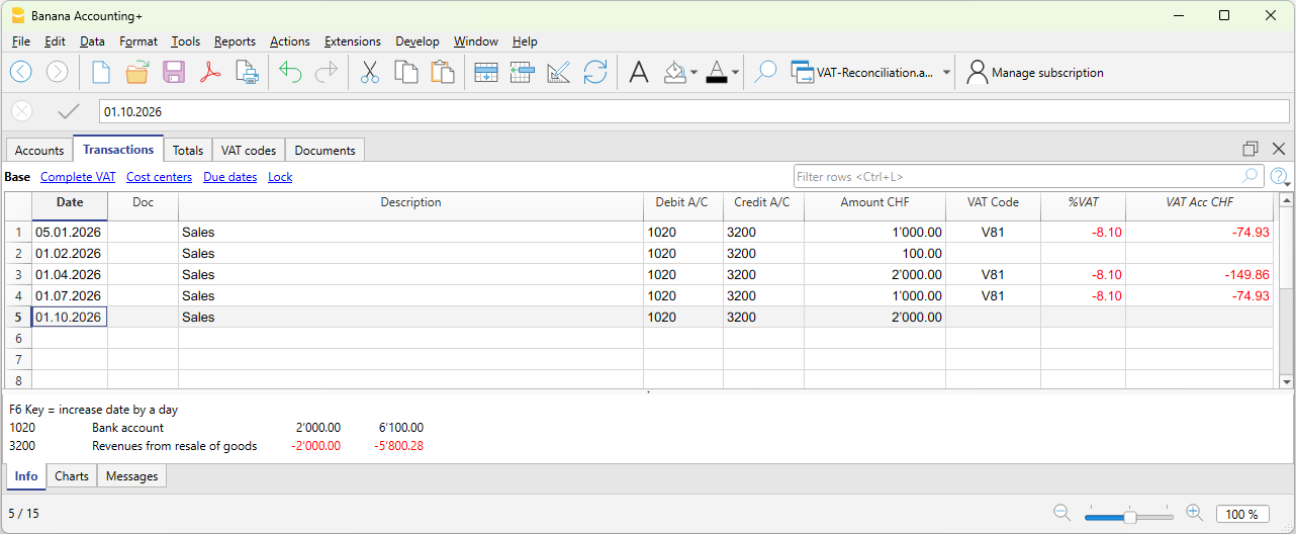
In these cases, once the error has been identified, the VAT Return for the affected quarter must be generated again using the VAT Return extension, and the corrected figures must then be submitted in the correction return on the Swiss Federal Tax Administration (FTA) portal.