Templates
The templates are preconfigured with Investment Balance Sheet Accounts, an Items table for managing individual investments, and example transactions covering the main investment operations. The chart of accounts can be customized to suit your specific requirements.
We provide three predefined accounting templates to help you get started with Banana Investment Accounting:
The Double-Entry Accounting with Integrated Investment Accounting template is suitable for managing investments in the accounting base currency. Investment transactions are recorded directly within your financial accounting.
The Double-Entry Multi-Currency Accounting with Integrated Investment Accounting template allows you to manage investments denominated in foreign currencies directly within your financial accounting. The Exchange Rates table is used to define currencies and exchange rates, and the accounting structure includes the accounts required to record exchange rate gains and losses.
The Multi-Currency Investment Accounting in a Separate File template allows you to keep detailed Investment Accounting separate from your general accounting. The Banana file can be used as an investment subledger, maintaining the details of individual investments and their transactions, while aggregated accounting values can be recorded in your general accounting.
Investment Accounting Extensions
The Investment Accounting Extensions help automate key investment accounting operations. They can be used to:
- calculate the data required when selling investments, including realized gains and losses;
- calculate exchange rate differences;
- update current Market Prices;
- create Market Value Adjustment transactions.
Together with the predefined templates, the extensions provide an integrated workflow for recording transactions, maintaining investment information, updating valuations, and keeping investment data consistent with the related accounting balances.
Double-Entry Accounting with Integrated Investment Accounting
Double-Entry Accounting with Integrated Investment AccountingThe tutorial file provides a ready-to-use example of integrated Investment Accounting, where the company's financial accounting and the detailed management of investments are maintained in the same Banana Accounting file.
All investments are managed in the accounting base currency, making this template suitable for learning and applying the basic principles of Investment Accounting without the additional complexity of foreign currencies.
The file includes a complete accounting structure for recording both the company's general business activities and its investment transactions. Investment-specific information, such as quantities, prices, Book Values, and Market Values, is managed alongside the corresponding accounting entries.
Chart of Accounts
The chart of accounts provides a complete double-entry accounting structure for high-net-worth individuals (HNWIs), integrating Investment Accounting with the management of real estate properties, other personal assets, liabilities, income, and costs.
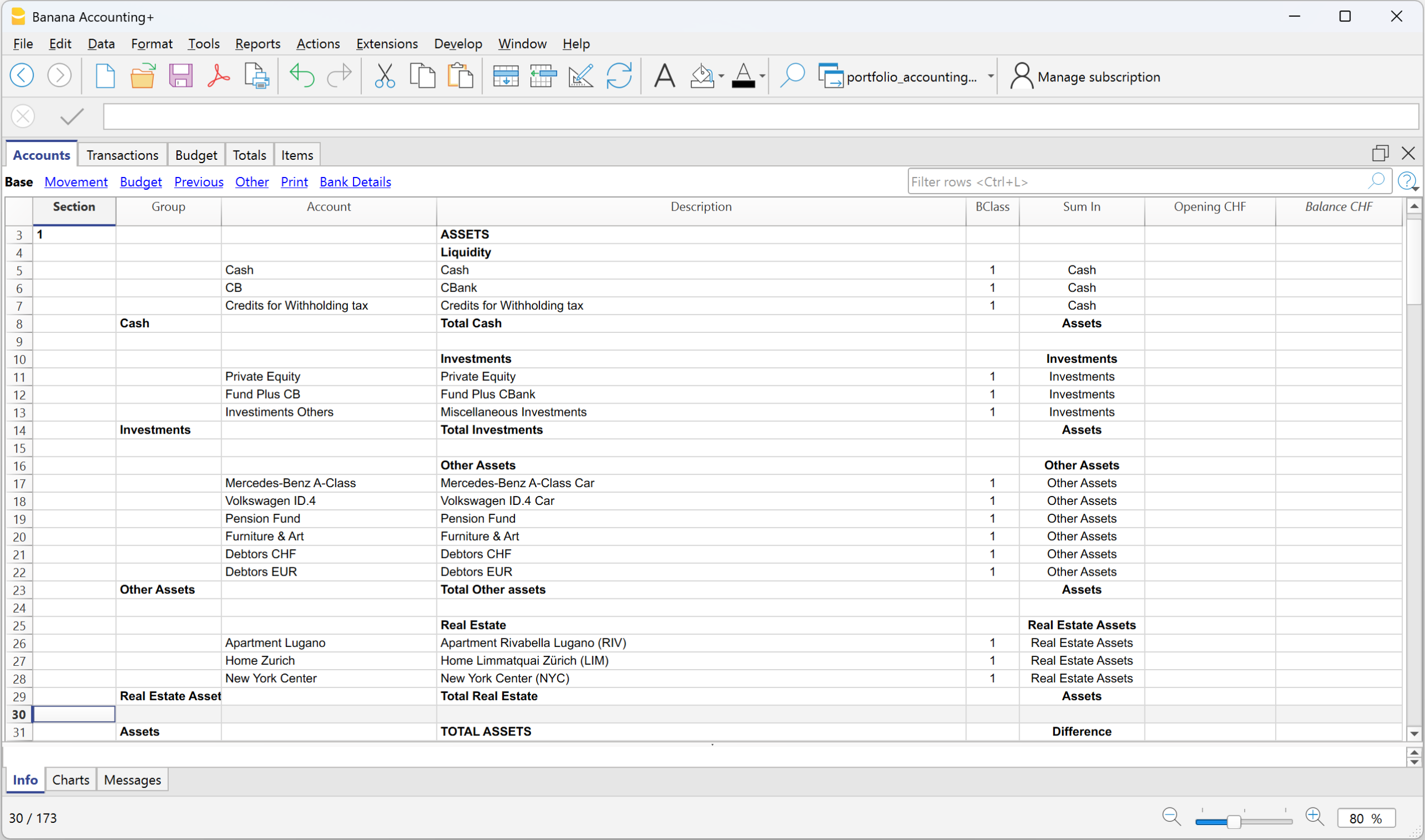
Balance Sheet Accounts
The Balance Sheet Accounts are organized into the following main categories:
- Liquidity, including cash, bank accounts, and withholding tax receivables;
- Investments, with dedicated Investment Balance Sheet Accounts for securities and other financial investments;
- Other Assets, including cars, pension assets, furniture and art, and receivables;
- Real Estate Assets, with separate accounts for each owned property;
- Debts, including other debts, loans, and mortgages;
- Equity, including equity and the current year profit or loss.
This structure makes it possible to manage securities, real estate properties, and other personal assets and liabilities within the same accounting file.
Profit & Loss Accounts
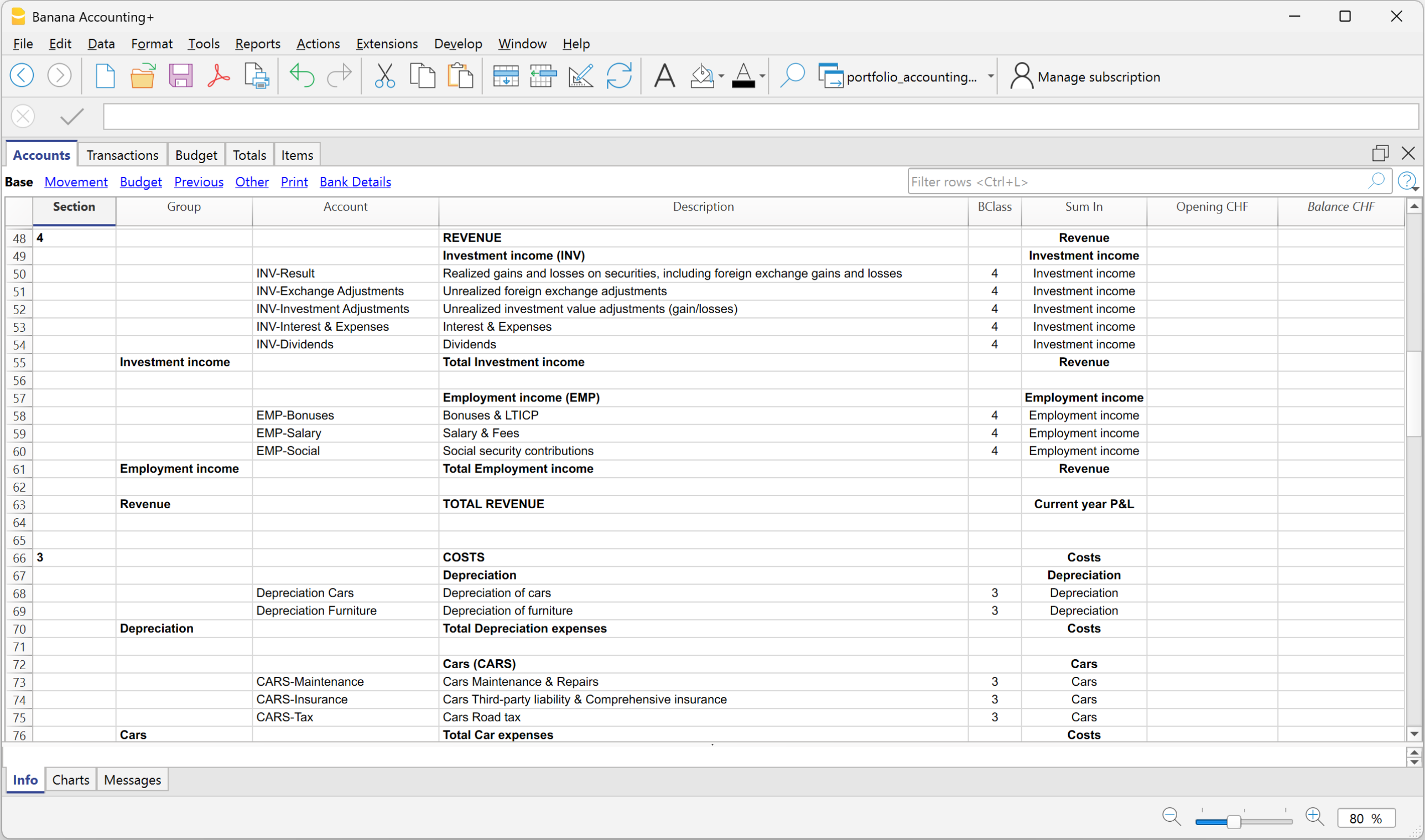
The Profit & Loss statement is structured to record both investment results and the other income and costs related to the individual's assets and personal finances.
Investment income and results include accounts for realized gains and losses on securities, foreign exchange results, unrealized investment and exchange rate adjustments, interest, dividends, and investment-related expenses.
The Profit & Loss statement also includes:
- Employment income, such as salary and bonuses;
- Depreciation, including depreciation of cars and furniture;
- Personal and asset-related costs, including cars, insurance, administration, legal fees, interest, taxes, health, and family costs;
- Real Estate Revenue and Costs, organized separately for each property, allowing rental and other income to be compared with utilities, insurance, maintenance, condominium fees, and other property-specific costs.
The structure therefore makes it possible to determine the overall financial result while also keeping investment results and the results of individual real estate properties clearly identifiable.
Because Investment Accounting is integrated into the financial accounting, purchases, sales, investment income and costs, realized gains and losses, and valuation adjustments are recorded directly in the same accounting file and are reflected in the corresponding Balance Sheet and Profit & Loss accounts.
Managing Quantities, Prices, and Values
The details of individual investments are managed in the Items table. The tutorial file includes sample shares and bonds and shows how investment-specific information can be maintained alongside the financial accounting.
For each investment, the Items table contains information such as the Item identifier, description, Asset Account, Quantity, Unit Price, Book Value, Market Price, and Market Value.
For more information, see the Items page.
Transactions
Investment transactions are recorded directly in the same Transactions table used for the company's general accounting.
The tutorial file contains example transactions covering the main investment operations, such as purchases, sales, income, costs, realized gains and losses, and valuation adjustments.
Because the investment transactions are part of the double-entry accounting, their accounting effects are immediately reflected in the corresponding accounts and in the company's Balance Sheet and Profit & Loss statement.
For more information, see Investment Accounting Transactions.
Other Resources
Other Banana Accounting templates are available depending on how you want to manage your investments:
- Double-Entry Multi-Currency Accounting with Integrated Investment Accounting – for managing investments denominated in foreign currencies directly within multi-currency double-entry accounting.
- Multi-Currency Investment Accounting in a Separate File – for keeping detailed Investment Accounting in a separate Banana Accounting file that can be used as an investment subledger for your general accounting.
为包含投资组合管理及外汇业务的金融公司提供的复式记账模板
为包含投资组合管理及外汇业务的金融公司提供的复式记账模板 匿名 (未验证)Multi-Currency Investment Accounting in a Separate File
Multi-Currency Investment Accounting in a Separate FileWith Banana Accounting, you can also manage investments in a file separate from your general accounting.
If you use other software for your general accounting and currently manage investments with Excel or other separate tools, you can use Banana Accounting with the Investment Accounting extension to maintain complete and detailed Investment Accounting.
With the Investment Accounting extension, you can automate several operations, such as calculating realized gains and losses on sales, creating adjustments for unrealized gains and losses, updating Market Prices, and calculating exchange rate differences for investments in foreign currencies.
This solution is particularly useful if you use other software for your general accounting or if you want to keep detailed Investment Accounting separate from your general accounting.
The Banana file can be used as an investment subledger: it maintains the details of individual investments and their related transactions, while in the general accounting you can record the required accounting values, including aggregated amounts by account or investment category.
Investment Accounting is therefore managed on two levels:
- In the general accounting file, you record all general accounting transactions, including the accounting values related to investments that are required for preparing the financial statements.
- In the Banana Investment Accounting file, you maintain all the details of individual investments, including quantities, prices, Book Values, Market Values, realized and unrealized gains and losses, as well as the related accounting transactions.
The principle is simple: the Banana file maintains the details of the investments, while the general accounting receives the required accounting effects.
The following sections explain how the example file works and how to integrate the resulting accounting data into the general accounting.
Chart of Accounts
The chart of accounts in the example file is intentionally concise and has been created specifically for Investment Accounting and for using the functions provided by the Investment Accounting extension.
The Accounts table contains only the accounts required to record Investment Accounting transactions and obtain the related Balance Sheet and Profit & Loss statement values.
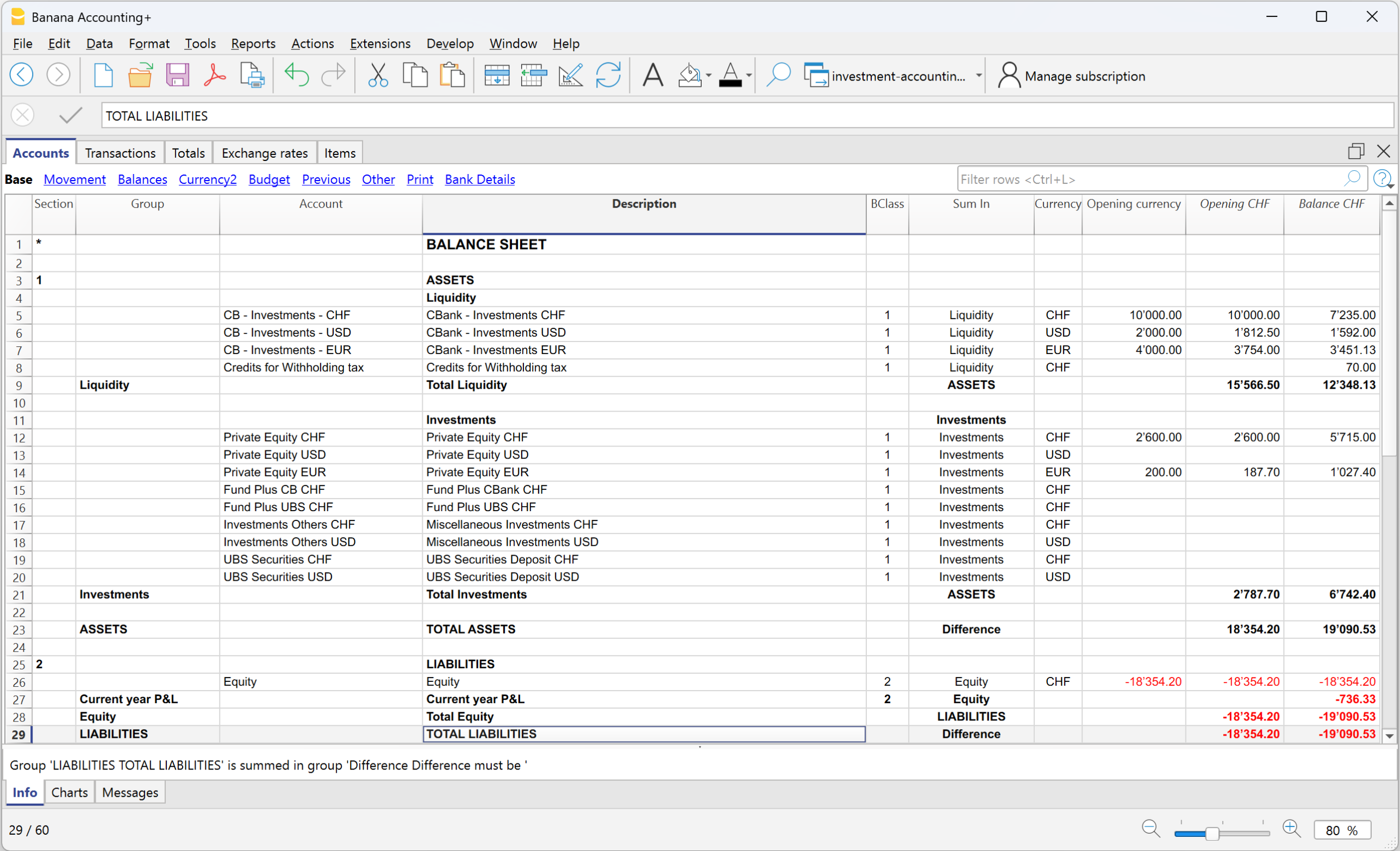
Balance Sheet
Asset Accounts
The Balance Sheet mainly includes bank accounts, investment accounts, and the withholding tax receivable account required for managing investments.
The example file includes separate accounts by currency to properly manage investments and their related multi-currency transactions.
The bank accounts in the Banana Investment Accounting file are technical accounts used as counterpart accounts for recording cash flows related to investments. Their balances do not necessarily correspond to the balances of the bank accounts in the general accounting, where the cash flows of the entire business are recorded.
Liability and Equity Accounts
These include Equity and the Current Year Profit or Loss required to complete the accounting structure of the file.
Profit & Loss Accounts
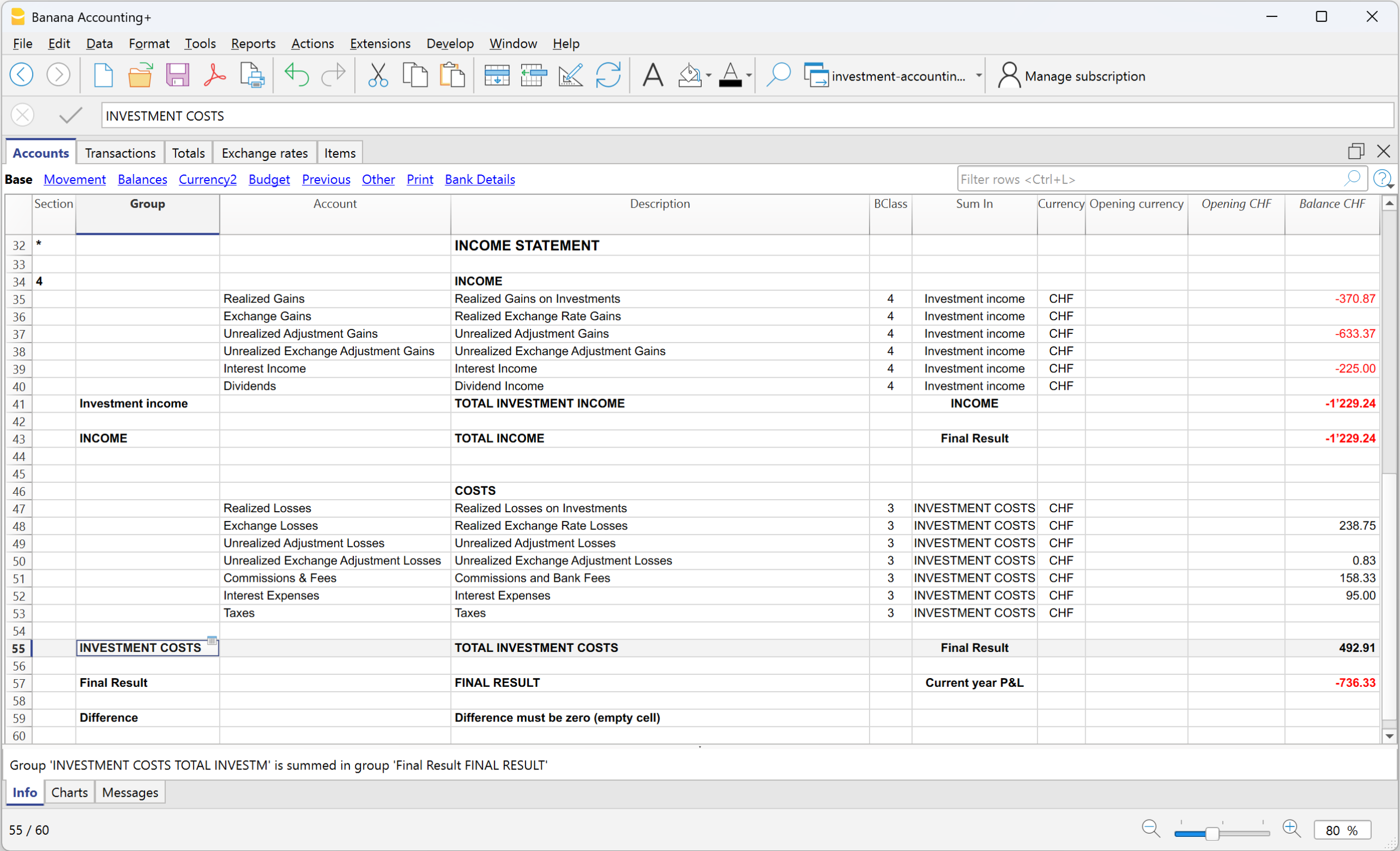
The Profit & Loss statement contains only the accounts required to record the income and expenses arising from investment transactions, such as interest, dividends, commissions and fees, realized gains and losses, unrealized value adjustments, and exchange rate differences.
Opening Balances
The opening balances of the Investment Balance Sheet Accounts are entered in the Accounts table. For each Investment Balance Sheet Account, the opening balance in the Banana file must correspond to the sum of the opening values of the Items linked to the same Asset Account.
Opening balance of the Investment Balance Sheet Account in the Banana file = Sum of the opening values of the linked Items
When the corresponding Investment Balance Sheet Account is also present in the general accounting, the opening balance from the Banana file must be consistent with the opening balance of the corresponding account in the general accounting:
Opening balance of the Investment Balance Sheet Account in the Banana file = Opening balance of the corresponding Investment Balance Sheet Account in the general accounting
Managing Quantities, Prices, and Values
The details of individual investments are managed in the Items table. For each investment, the table contains information such as the Item identifier, description, Asset Account, Quantity, Unit Price, Book Value, Market Price, and Market Value.
For more information, see the Items page.

Transactions
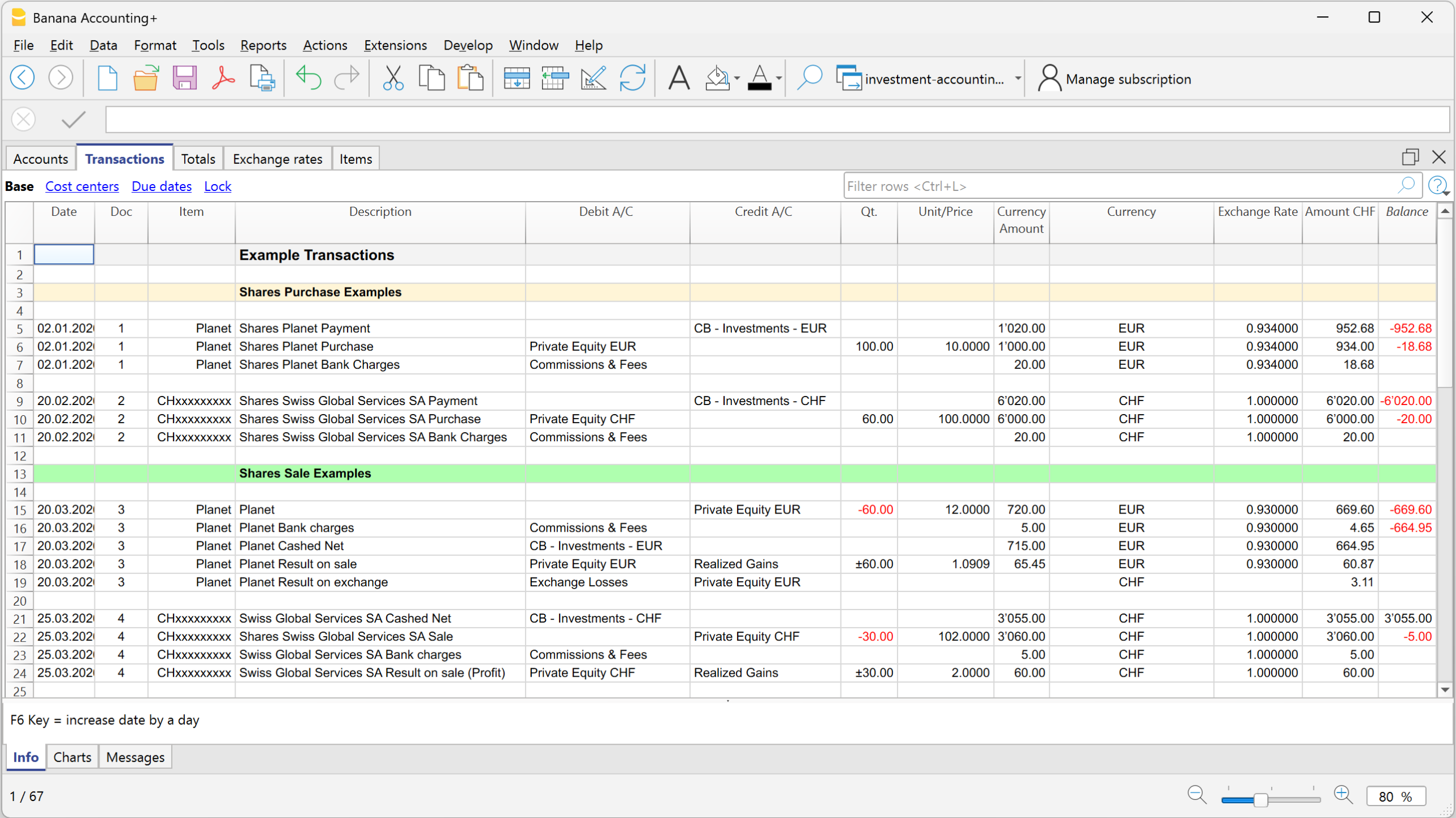
The example file contains transactions covering the main investment operations, including purchases, sales, dividends, interest, commissions and fees, realized gains and losses, value adjustments, and exchange rate differences.
The transactions contain both the standard double-entry accounting information and investment-specific information, such as Item, Quantity, and Unit Price.
For more information, see the Transactions page.
Updating and Reconciling the General Accounting
The Banana Investment Accounting file can be used as an investment subledger for your general accounting. It maintains the details of individual investments and their related transactions, while the required accounting values are recorded in the general accounting.
The transfer of these values is not automatic. You can update the general accounting in two main ways:
- Periodically, by keeping the detailed investment transactions in the Banana Investment Accounting file and transferring the required accounting values to the general accounting at regular intervals or when financial statements need to be prepared. This can be done, for example, at the end of a month, quarter, half-year, or year.
Important: When using periodic updates, it is not sufficient simply to record the difference between the opening and closing balance of an investment account. Purchases, sales, realized gains and losses, income, costs, and any applicable value or exchange rate adjustments must be transferred to the general accounting according to their accounting nature.
The values transferred to the general accounting can be recorded in aggregated form by investment account or category, provided that the required accounting information is maintained and the corresponding balances can be reconciled with the Banana Investment Accounting file.
- Transaction by transaction, by recording the corresponding accounting effects in the general accounting as the investment transactions are recorded in the Banana file.
After the required accounting values have been recorded in the general accounting, the Book Values resulting from the Banana file can be used to verify the corresponding investment account balances:
Book Value from the Banana file = Balance of the corresponding investment account in the general accounting
In this way, the Banana file maintains the detailed information for individual investments and their related transactions, while the general accounting contains the accounting values required for financial reporting.
Integrated Investment Accounting Templates
Other Resources
If you prefer to manage investments directly within your financial accounting instead of using a separate Investment Accounting file, you can use one of the following Banana Accounting templates with integrated Investment Accounting: